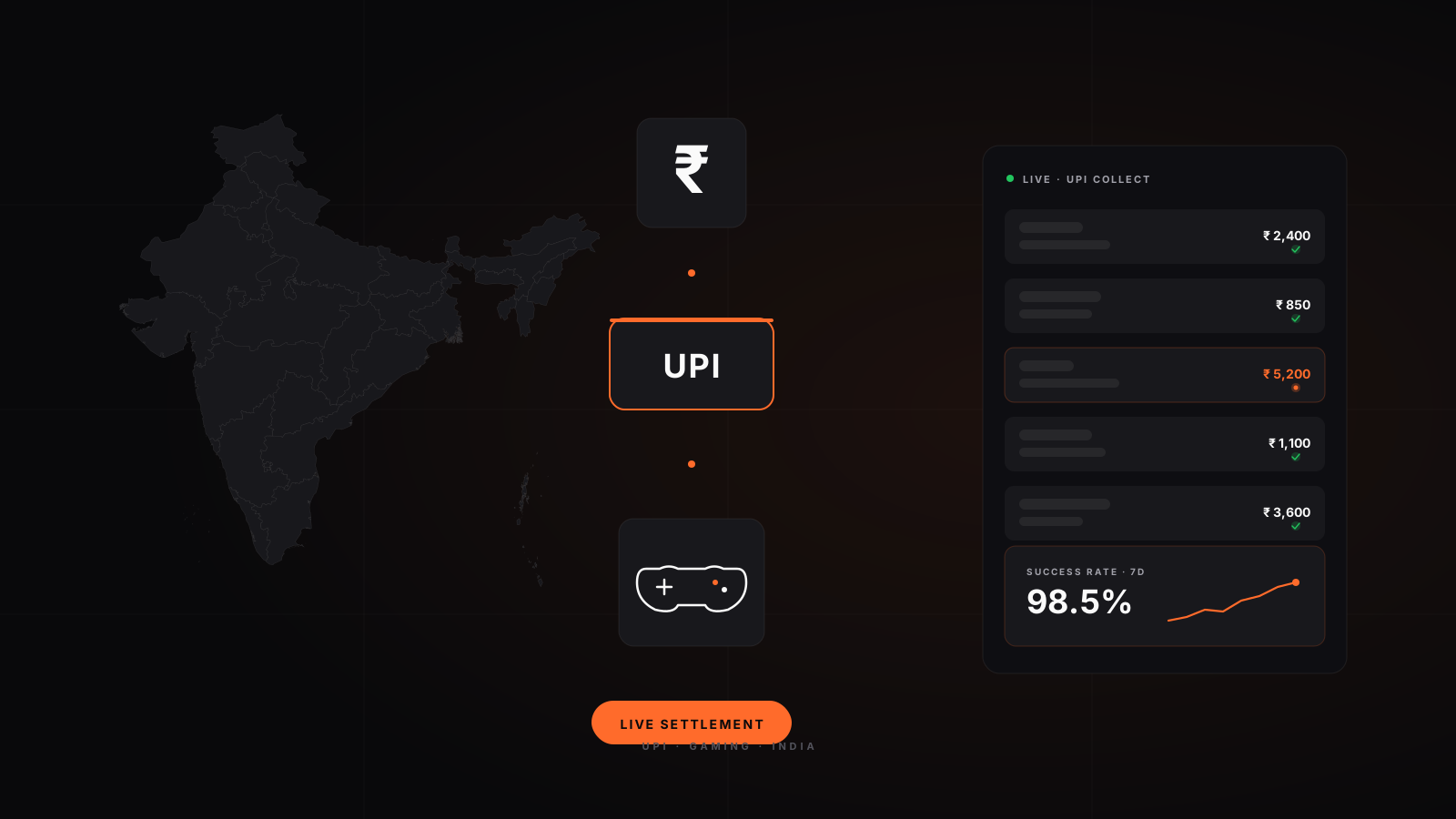
What Happened to UPI for iGaming in India
Until mid-2024, Indian iGaming and fantasy sports operators had workable (if imperfect) access to UPI through mainstream payment gateways. Razorpay, Cashfree, and PayU processed payments for gaming platforms with varying degrees of friction. Success rates were suboptimal (70 to 80%), but the infrastructure was there.
That changed between Q3 2024 and Q2 2025. Following sustained RBI pressure and a broader regulatory examination of payment aggregators, India's largest mainstream processors withdrew from the gaming vertical entirely. The exits were categorical, not performance-based, and affected compliant operators as much as non-compliant ones.
The scale of the disruption: Dream11, MPL, WinZO, My11Circle, and Zupee all had to restructure their payment infrastructure during this period. When platforms came back under the new compliance frameworks, most found their legacy payment processor relationships were gone.
The withdrawal was not caused by individual operator misconduct. It was a risk management decision by processors who served millions of e-commerce and SaaS merchants and concluded that gaming's regulatory exposure was not worth the revenue. This dynamic is unlikely to reverse under current regulatory conditions.
RBI Circulars and Notifications Affecting Gaming Payments
The regulatory pressure on payment aggregators did not appear from nowhere. A series of RBI circulars and NPCI notifications between 2023 and 2025 systematically tightened the framework for gaming-adjacent payment processing:
RBI Master Direction on Payment Aggregators (March 2020, amended 2023)
The foundational document governing payment aggregators in India. The 2023 amendment introduced enhanced merchant due diligence requirements, requiring aggregators to conduct risk-based merchant categorisation. Gaming was explicitly identified as a category requiring enhanced monitoring. Aggregators failing to maintain adequate merchant risk frameworks faced licence revocation.
NPCI Circular on Merchant Category Codes (2024)
NPCI issued guidance tightening the use of Merchant Category Codes (MCCs) for UPI transactions. Gaming merchants were required to use MCCs 7801 (Government-Licensed Online Casinos), 7802 (Government-Licensed Horse Racing), or 7995 (Betting / Casino Gambling). These codes trigger enhanced monitoring by acquiring banks. Aggregators routing gaming transactions under generic MCCs (e.g., 5999 for Miscellaneous Retail) were flagged for non-compliance.
RBI Enforcement Actions (2024–2025)
The RBI issued enforcement actions against several payment intermediaries for deficiencies in AML monitoring of gaming transactions. These actions, while not publicly naming specific gaming merchants, created significant regulatory liability for any aggregator with gaming merchants in their portfolio. The response from mainstream aggregators was swift and categorical: exit the gaming vertical before the next audit cycle.
What this means for operators: The regulatory environment is not hostile to gaming per se. It is hostile to gaming transactions processed through infrastructure not designed for the specific compliance requirements of the category. The answer is not to avoid payment processing; it is to use a processor built for this regulatory context.
State-by-State Gaming Legality Map
India's gaming landscape is a patchwork of central legislation and state-level rules. The central government permits skill-based real-money gaming under the Public Gambling Act 1867 (which predates online gaming). However, states retain the right to legislate on gambling, and several have exercised that right to restrict or ban specific gaming formats.
Maharashtra Prevention of Gambling Act: bans casinos and most gambling. Skill-based games in legal grey area.
Karnataka Police Act amendment 2021 banned online real-money gaming. Overturned partially by HC but remains restricted.
Tamil Nadu Prohibition of Online Gambling Act 2022. Real-money gaming prohibited. Significant enforcement activity.
AP Gaming Act amendment bans online gaming for money. Includes fantasy sports.
Telangana Gaming Act 2017 amended to cover online games. Broad prohibition on gaming for money.
Delhi Public Gambling Act permits skill-based games. Fantasy sports and rummy generally permitted.
Goa, Daman and Diu Public Gambling Act permits licensed casinos. Most progressive gaming jurisdiction.
West Bengal Gambling and Prize Competition Act: skill-based games permitted. Fantasy sports have operated without restriction.
For payment processors, this patchwork creates a specific compliance requirement: geo-restriction. Operators should block player registrations and deposits from states where their product is prohibited. Processors providing UPI to gaming merchants must verify that operators have geo-restriction controls in place as part of merchant onboarding.
UPI Transaction Limits for Gaming
UPI transaction limits are set by NPCI and can be further restricted by acquiring banks and UPI apps. Understanding the actual limits is critical for iGaming operators, particularly those with high-value depositing players.
| Limit Type | Amount | Notes |
|---|---|---|
| Per-transaction (standard) | ₹1,00,000 | NPCI default. Applies to most merchants. |
| Per-transaction (gaming, P2M) | ₹1,00,000 | Same as standard for compliant P2M merchants. |
| Daily limit (per UPI ID) | ₹1,00,000 | Most banks apply ₹1L daily. Some banks allow higher for P2M. |
| UPI Lite (small transactions) | ₹500 per transaction | Off-device wallet. Not applicable for gaming deposits. |
| UPI AutoPay (recurring) | ₹15,000 per transaction | For subscription models. Lower limit than standard UPI. |
| HDFC / ICICI / Axis P2M | ₹2,00,000 | Selected banks allow higher P2M limits for registered merchants. |
The ₹1 lakh per-transaction limit is the most significant constraint for high-value gaming operators. Players who wish to deposit more than ₹1 lakh in a session must make multiple transactions. A processor with good UX will handle this cleanly, displaying deposit amounts in chunks and triggering multiple UPI requests, but it requires intentional implementation.
For operators with VIP players regularly depositing ₹2–5 lakh per session, the right approach is to combine UPI with NEFT/IMPS for high-value transfers, routing players to the appropriate rail based on deposit amount.
P2P vs P2M UPI: Why Gaming Merchants Must Use P2M
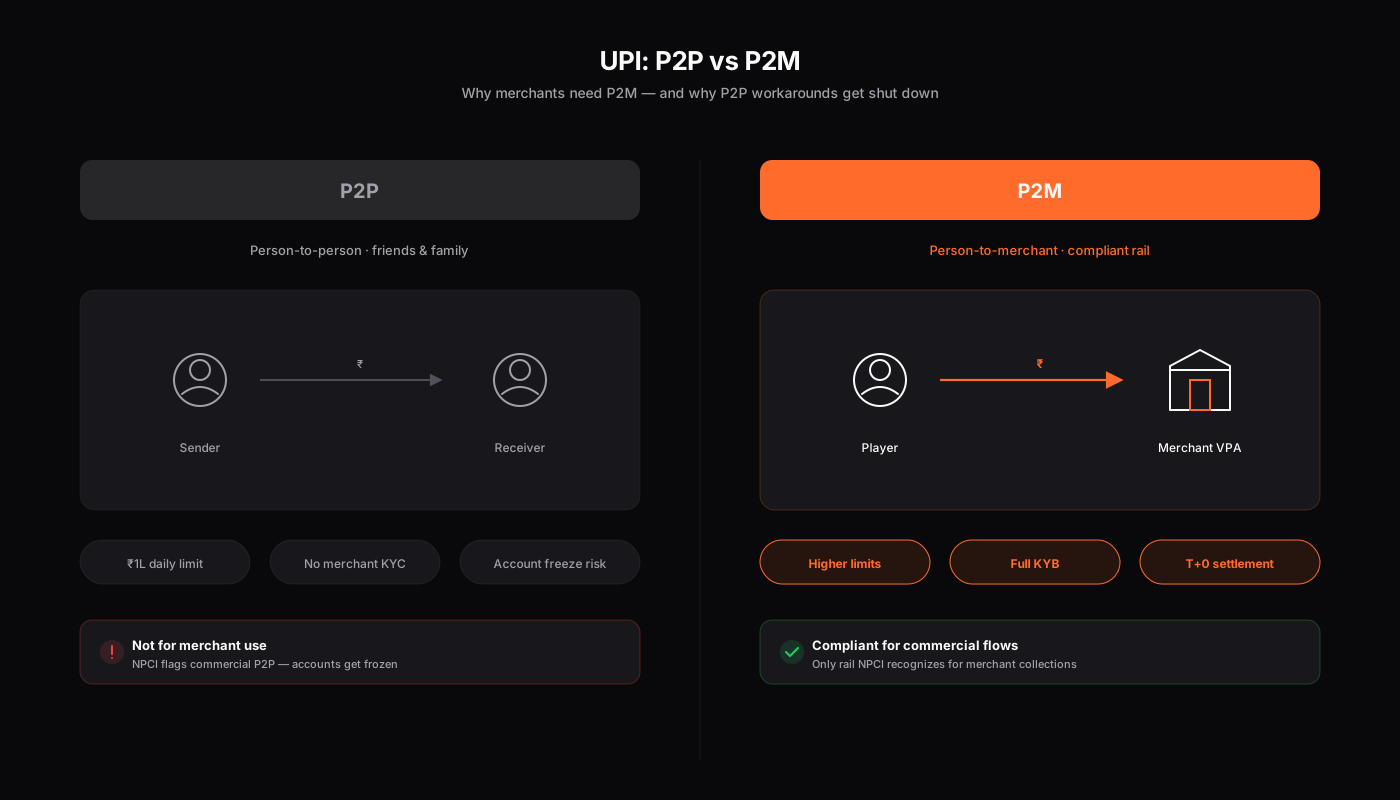
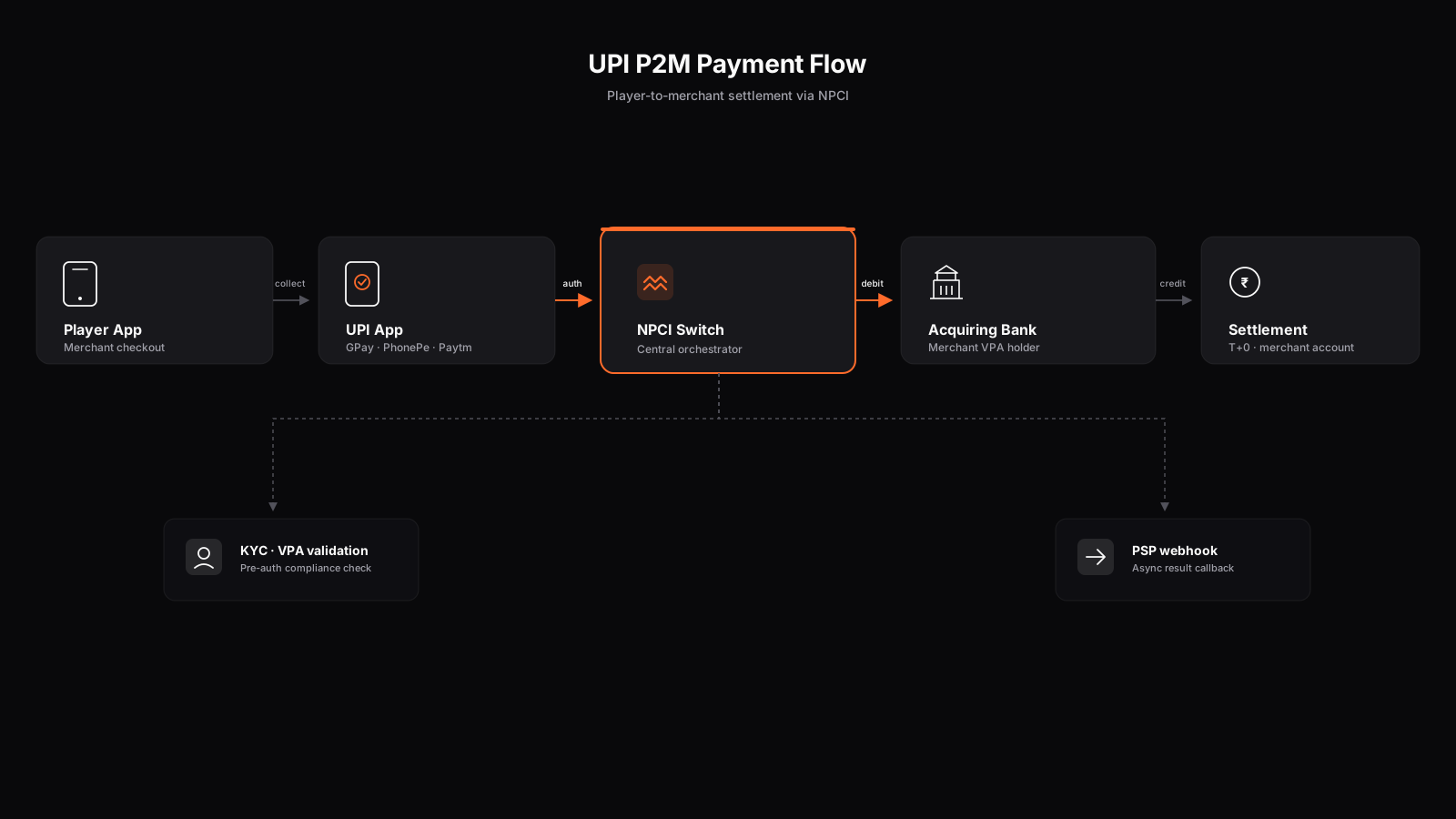
This is one of the most important technical and compliance distinctions for Indian gaming operators. P2P and P2M UPI are fundamentally different payment flows with different regulatory treatment.
P2P UPI (Person-to-Person)
P2P UPI transfers money between two individual bank accounts via UPI IDs (e.g., user@okaxis to merchant@okaxis). Some gaming operators have historically used P2P flows, essentially collecting deposits into a personal or business bank account rather than through a proper merchant payment infrastructure. This is a compliance violation for several reasons:
- P2P transactions are not subject to GST TCS (Tax Collected at Source) reporting that gaming operators are required to comply with
- P2P flows create AML monitoring gaps: the transaction appears as a personal transfer, not a merchant deposit
- NPCI and RBI have issued specific guidance that gaming platforms must use merchant payment infrastructure, not P2P workarounds
- Banks that discover P2P accounts being used for gaming collection consistently close those accounts
P2M UPI (Person-to-Merchant)
P2M UPI is the correct infrastructure for gaming merchants. In a P2M flow:
- The merchant has a registered VPA (Virtual Payment Address) linked to a business bank account via a payment aggregator
- Transactions are tagged with the merchant's MCC and appear in acquiring bank records as merchant transactions
- Settlement flows directly to the merchant's designated settlement account, not a personal bank account
- The entire flow is compliant with RBI merchant payment guidelines and NPCI merchant registration requirements
The bottom line: If your gaming platform is collecting UPI deposits through anything other than a registered P2M merchant account, you are operating outside RBI guidelines. When discovered (and it is discovered), accounts are frozen, funds are held, and the platform loses its payment access. Use proper P2M merchant UPI infrastructure from day one.
KYC Requirements for UPI Gaming Transactions
Gaming operators in India face a layered KYC obligation: both for merchant onboarding with the payment processor and for their own player KYC requirements under gaming and tax regulations.
Merchant KYC (required by the payment processor)
- Certificate of Incorporation (ROC filing)
- GST registration certificate
- PAN of the company
- PAN and Aadhaar of all directors and beneficial owners with ≥25% shareholding
- Business bank account details (cancelled cheque or bank statement)
- Platform terms of service and responsible gaming policy
- Proof of gaming licence or licence application (where applicable)
Player KYC (required by the operator under IT Act and gaming regulations)
- PAN mandatory for any player whose annual withdrawals exceed ₹10,000 (under Income Tax Act Section 194B provisions for gaming winnings)
- Full KYC (PAN + address proof) for players depositing more than ₹50,000 per year, aligned with financial intermediary AML standards
- Aadhaar-linked verification recommended (not yet mandatory but likely to become so under future DPDP Act implementation)
- Self-exclusion database check: operators should screen against the MeitY self-exclusion registry where applicable under the Online Gaming (Regulation) framework
Integration Guide: UPI Collect vs UPI Intent
UPI supports two primary payment initiation flows. Choosing the right one significantly affects conversion rates for gaming platforms.
UPI Collect
In a Collect flow, the merchant sends a payment request to the player's UPI ID. The player receives a push notification in their UPI app and approves the payment there.
Best for: Desktop web platforms where the player is not on a mobile device. The player enters their UPI ID on the payment page, the merchant initiates a Collect request, and the player approves on their phone.
Limitation: Requires the player to actively switch to their UPI app to approve. Higher drop-off than Intent flows on mobile.
UPI Intent
In an Intent flow, the merchant generates a UPI payment link or QR code. On mobile, this deep-links directly into the player's installed UPI app (GPay, PhonePe, Paytm), pre-filling the payment details. The player only needs to enter their PIN to complete.
Best for: Mobile gaming apps where the player is already on their phone. The entire flow stays on one device with no app switching friction.
Conversion impact: Intent flows on mobile typically convert 15–25% better than Collect flows for the same transaction value. For gaming operators where most players are on mobile, Intent is the correct default.
Recommendation for iGaming operators
- Mobile app (Android/iOS): Use UPI Intent as primary, with UPI Collect as fallback if Intent deep-link fails
- Mobile web: Use UPI Intent with app-specific deep links (GPay, PhonePe, Paytm) displayed as separate options; universal UPI QR as fallback
- Desktop web: Use UPI Collect as primary; display a QR code the player can scan with their phone as an alternative
UPI Gateway Options for iGaming Merchants in 2026
| Gateway | Accepts iGaming | UPI Success Rate | P2M Merchant UPI | Approval Time |
|---|---|---|---|---|
| Razorpay | No | N/A | N/A | N/A |
| Cashfree | No | N/A | N/A | N/A |
| PhonePe Business | No | N/A | N/A | N/A |
| PayU India | No | N/A | N/A | N/A |
| FalconPay | Yes | 98.5% | Yes | 48 hours |
What "98.5% UPI Success Rate" Actually Means
Most merchants migrating from mainstream processors are surprised by the difference in UPI success rates. When Razorpay and Cashfree were still accepting gaming merchants, typical success rates ran 70–80%. FalconPay achieves 98.5% for its gaming merchants. The gap is technical, not commercial.
Direct bank relationships
FalconPay has direct integrations with 100+ Indian banks rather than routing through an aggregator layer. Every aggregator layer introduces latency and a potential failure point. A direct bank integration means fewer hops, faster response times, and fewer timeout failures.
Multi-bank routing
Every UPI transaction is intelligently routed across multiple acquiring banks in real time. If the primary route returns a bank-side failure (insufficient liquidity, technical timeout, velocity limit), the transaction is retried on an alternative route in milliseconds, invisibly to the player. The player sees a seamless payment; the routing engine has tried three different banks in the background.
Gaming-tuned transaction logic
Gaming deposits have specific transaction patterns: higher frequency, clustered timing (players deposit when they want to play, often in the evenings), and higher sensitivity to latency (a slow payment page increases abandonment more in gaming than in e-commerce). FalconPay's retry logic, timeout thresholds, and failure handling are tuned specifically for gaming transaction behaviour, not borrowed from e-commerce defaults.
Ready to process UPI for your Indian iGaming platform?
FalconPay approves Indian iGaming merchants in 48 hours. 98.5% UPI success rate, P2M merchant infrastructure, T+1 INR settlement.
Apply for India UPI Processing →Frequently Asked Questions
Which UPI gateways work for iGaming merchants in India in 2026?
Mainstream gateways (Razorpay, Cashfree, PayU, PhonePe Business) have all withdrawn from iGaming as of 2025. Specialist processors like FalconPay are among the few with active UPI merchant infrastructure for gaming merchants, with a 98.5% transaction success rate.
Is UPI for online gaming legal in India?
Skill-based real-money gaming is legal at the central level. Legality varies by state; Tamil Nadu, Andhra Pradesh, Telangana, and Karnataka have enacted additional restrictions. Operators must geo-restrict players from prohibited states and comply with both central and state regulations.
What is the UPI transaction limit for gaming deposits?
The standard NPCI per-transaction limit is ₹1,00,000. Daily limits are typically ₹1,00,000 per UPI ID, though some banks allow higher P2M limits for registered merchants. For deposits above ₹1 lakh, operators should offer NEFT/IMPS as supplementary options.
What is the difference between P2P and P2M UPI for gaming?
P2M (person-to-merchant) UPI is the legally correct flow for gaming platforms: it routes through a registered merchant VPA, settles to a business account, and complies with RBI merchant payment guidelines. P2P UPI workarounds (collecting into personal accounts) violate RBI guidelines and result in account closures when discovered.
What KYC documents are required for UPI gaming transactions?
Merchant KYC requires GST registration, Certificate of Incorporation, and director PAN/Aadhaar. For player KYC, operators must collect PAN for withdrawals above ₹10,000 and full KYC for deposits above ₹50,000 per year under IT Act provisions.
Should I use UPI Collect or UPI Intent for my gaming platform?
For mobile gaming apps: use UPI Intent (deep-links into the player's UPI app on the same device). For desktop: use UPI Collect (player enters UPI ID, approves on their phone). Intent flows convert 15–25% better on mobile, which is where the majority of Indian gaming players transact.