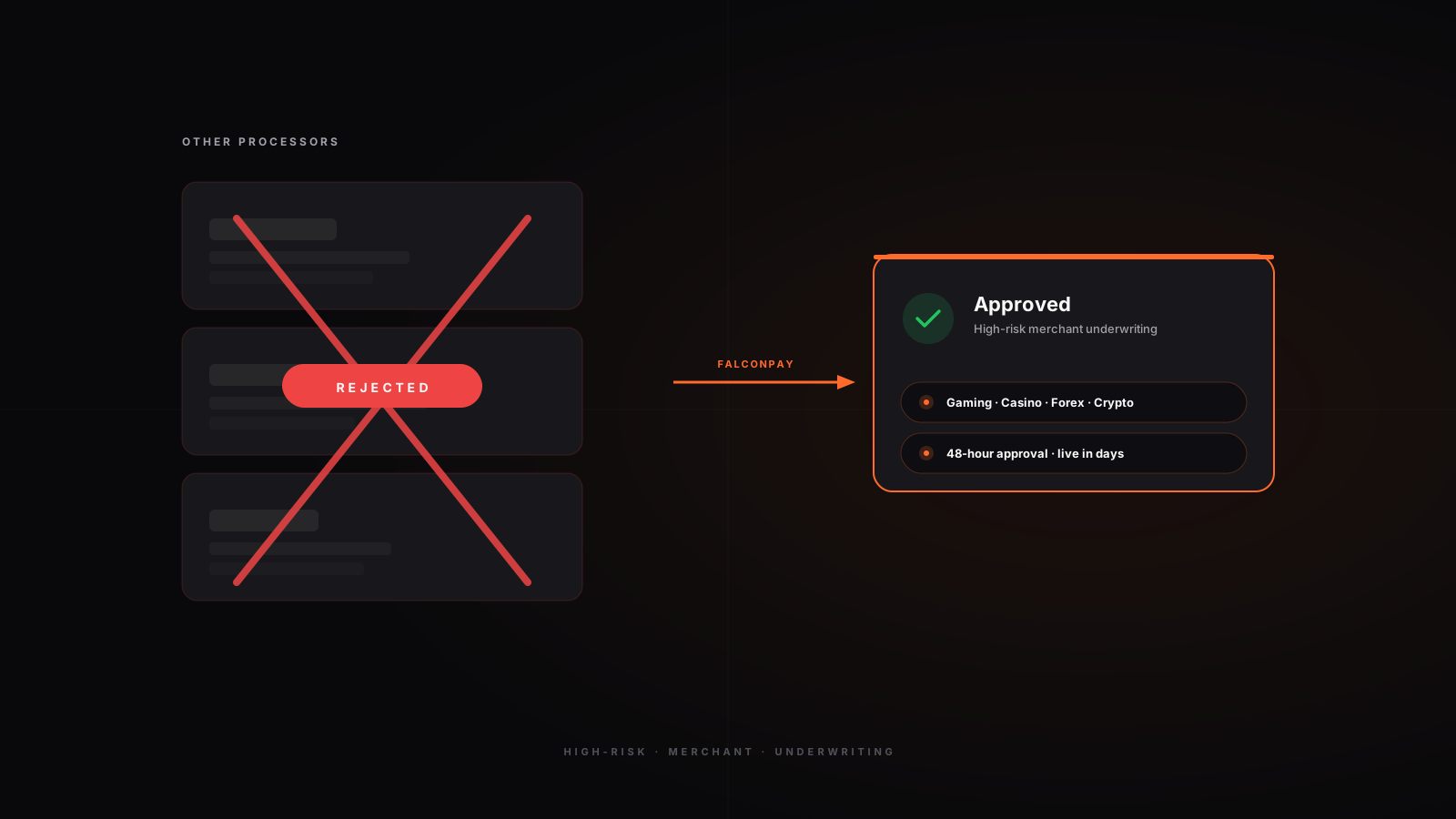
Why Gaming Merchants Get Rejected
Every payment processor operates under a web of agreements, with Visa and Mastercard at the top, then acquiring banks, then the processor itself. These agreements define which merchant categories can be onboarded, at what chargeback thresholds, and with what compliance requirements.
Gaming and gambling occupy a category that creates problems at every layer of this stack. The reasons are structural, not personal. Your individual business quality is largely irrelevant to the rejection decision.
The chargeback maths
The gaming industry averages 1.5–3% chargebacks across the category. Visa's threshold for its Dispute Monitoring Program is 0.9%. Mastercard's threshold for its Excessive Chargeback Program is 1.5%. Processors that let their portfolio chargeback rate drift above these thresholds face fines of $25,000–$100,000 per month from the card networks.
Even if your specific platform runs at 0.3% chargebacks (excellent by any measure), processors see the category average, not your individual rate. The risk-adjusted revenue calculation doesn't work in your favour at a processor whose primary business is e-commerce and SaaS.
Regulatory fragmentation
Gambling legality varies not just by country but by state, province, and sometimes municipality. In India alone, real-money gaming is legal at the federal level for skill-based games but banned in states like Tamil Nadu, Andhra Pradesh, and Karnataka for certain categories. A processor serving 50 countries cannot build per-jurisdiction compliance logic for a merchant category that represents 0.3% of their volume. Blanket bans are the efficient solution.
Reputational exposure
Stripe processes payments for Shopify, Amazon, and thousands of household-name brands. Their product positioning is clean, mainstream, and enterprise-grade. Being publicly known as the payment processor for online casinos, even fully licensed ones, conflicts with this positioning. The downside is asymmetric: the revenue from gaming merchants is small; the reputational risk of a high-profile gambling scandal is not.
The AML and KYC overhead
Gaming transactions are scrutinised by financial intelligence units in most jurisdictions. AML rules require processors to monitor for structuring, layering, and unusual transaction patterns that appear frequently in gambling. Building and maintaining robust AML systems for gaming merchants requires dedicated compliance teams. For processors where gaming is a marginal revenue contributor, this investment doesn't compute.
Stripe's Exact Prohibited Businesses Policy
Stripe publishes their restricted businesses list publicly. The exact language, as of 2026, prohibits the following gaming and gambling categories:
- "Gambling activities including, but not limited to: sports betting, online casino games, poker, lottery, and fantasy sports with real-money prizes"
- "Skill-based games with money prizes, whether classified as gambling or not by local law"
- "Aggregators or intermediaries that enable gambling transactions"
- "Any platform where users can deposit money to play games, regardless of the payout structure"
This policy is global. There are no carve-outs for regulated operators, no exceptions for specific jurisdictions, and no appeal process. Stripe has made a deliberate strategic decision to be a mainstream processor and gaming is outside that positioning.
Practical implication: If your platform involves any real-money gaming element, even a skill-based app with prize payouts, Stripe will eventually terminate your account. The question is whether it happens at onboarding or six months later after you've built your entire stack on them.
What happens if Stripe discovers your account is being used for gaming after onboarding? Your account is suspended immediately, your funds are held for a minimum of 90 days (and up to 180 days), and any chargebacks during the hold period are deducted from the held balance before you receive it. Multiple merchants have reported held balances of $200,000–$2M during these periods.
Razorpay's Gaming Restrictions in India
Razorpay's situation is different from Stripe's. It's not a philosophical choice but a regulatory one. The timeline of Razorpay's withdrawal from gaming is as follows:
- Q3 2024: RBI issues guidance tightening oversight of payment aggregators processing gaming transactions. Razorpay begins enhanced monitoring of gaming merchant accounts.
- Q4 2024: Razorpay stops accepting new gaming merchant applications. Existing merchants continue to process but are flagged for review.
- Q1 2025: Razorpay begins offboarding gaming merchants with 30–90 day notice periods. Fantasy sports platforms are the first category to receive termination notices.
- Q2 2025: Full withdrawal complete. No gaming or gambling transactions processed through Razorpay as of June 2025.
The specific Razorpay merchant agreement clause that was invoked reads: "Razorpay reserves the right to terminate merchant agreements in any category where regulatory guidance creates material compliance risk, regardless of the merchant's individual compliance status."
This clause, which is standard in most payment processor agreements, meant even perfectly compliant gaming merchants were offboarded. It was a category-level decision, not a performance-based one.
Cashfree followed a nearly identical timeline. PayU restricted gaming merchant onboarding in Q3 2024 and completed its withdrawal by Q1 2025.
PayPal's Gambling Policy by Country
PayPal is more geographically nuanced than Stripe but less reliable than a specialist processor. Their gambling policy varies significantly by country:
| Market | PayPal Gambling Status | Notes |
|---|---|---|
| United Kingdom | Limited | Permitted for UKGC-licensed operators only. Subject to enhanced monitoring. |
| Germany | Limited | State-licensed sports betting only. Online casino restricted. |
| France | Limited | ANJ-licensed operators. Sports betting and poker permitted. |
| India | Prohibited | All gaming and gambling transactions prohibited. |
| Brazil | Prohibited | Gambling transactions not supported through PayPal Brazil. |
| United States | Prohibited | Online gambling prohibited federally. No state-level exceptions via PayPal. |
| Rest of World | Prohibited | Default policy prohibits gambling transactions globally outside listed exceptions. |
Even where PayPal permits gambling transactions, the practical reality is difficult: approval processes are opaque, account reviews are frequent, and merchant accounts can be restricted without warning. PayPal should not be used as a primary payment method for any serious gaming operation.
What Happens When Your Account Is Closed
Understanding this timeline is critical. It determines how much capital you have at risk at any given moment with a mainstream processor.
Immediate termination (Day 0)
When a processor decides to terminate a gaming merchant account, the account is suspended immediately. You lose the ability to process new transactions from the moment of notification. If termination is triggered by pattern detection (rather than manual review), it can happen without prior warning.
The funds hold (Days 1–180)
Funds in your account at the time of termination are placed in a reserve. The processor holds these funds to cover potential chargebacks. The hold period varies:
- Standard hold: 90 days for most Stripe terminations
- Extended hold: Up to 180 days if the processor determines elevated chargeback risk
- Disputed hold: Indefinite if the processor is disputing your compliance status or investigating fraud
During the hold period, chargebacks from the preceding 90–180 days are deducted from the held balance. For gaming platforms with high transaction volumes, the practical impact can be severe: a platform processing $500,000/month with a 1.5% chargeback rate could face $45,000–$90,000 in chargeback deductions from the held balance alone.
The MATCH list risk
If your account is terminated for cause (not just category policy, but for a specific violation like misrepresenting your business type), you may be added to the MATCH list (Member Alert to Control High-Risk Merchants). This is a Mastercard-maintained database of merchants who have been terminated for cause. Banks and processors check this list during underwriting. A MATCH listing makes it extremely difficult to get approved by any mainstream processor for 5 years.
The most important rule: Never misrepresent your business category to get through underwriting. The short-term gain of processing for a few months is not worth a 5-year MATCH listing. Apply only to processors who genuinely serve gaming merchants.
Chargeback liability after termination
Your chargeback liability doesn't end when your account closes. Cardholders have up to 120 days from a transaction to file a chargeback (in some cases longer). If you processed $1M in transactions in the 120 days before account closure, chargebacks can still arrive for those transactions months after you've stopped processing. This is why processors hold funds, and why your held balance can be significantly reduced by the time you receive it.
How to Switch Processors Without Payment Downtime
Switching processors is not a day-one project. Done correctly, it requires 3–4 weeks and produces zero downtime. Here is the step-by-step approach:
Step 1: Apply to your new processor first (Week 1)
Start the application process with a specialist high-risk processor before you have any urgency. Underwriting for gaming merchants typically takes 3–10 business days. You want this complete before your existing processor shows any signs of restricting your account.
Step 2: Parallel integration (Week 2)
Integrate the new processor's API in your staging environment. Do not cancel your existing processor. Build the integration as if the new processor will be your primary. Test the full payment flow including webhooks, refunds, and chargeback notifications.
Step 3: Shadow traffic testing (Days 15–21)
Route a small percentage of real transactions (5–10%) to the new processor while your existing processor handles the remainder. This validates the integration against real payment instruments and identifies any edge cases in the integration. Monitor success rates, failure codes, and settlement timing.
Step 4: Full cutover (Day 22+)
Once you've confirmed the new processor is working correctly on live traffic, route 100% of new transactions through it. Keep your old processor account open (do not close it) until all pending settlements and chargeback windows have cleared, typically 90 days.
What not to do
- Do not close your old processor account before chargebacks settle; you need the account open to receive held funds
- Do not migrate mid-month. End-of-month settlement reconciliation becomes complex
- Do not tell your old processor you're switching, because this can trigger accelerated account review
What Documents Make a Gaming Merchant Approvable
From a compliance perspective, what separates an approved gaming merchant from a declined one is documentation, not the business itself. Here is what specialist processors need to see:
Tier 1: Minimum requirement (all applicants)
- Certificate of incorporation showing business registration in a recognised jurisdiction
- Proof of identity for all beneficial owners with ≥25% ownership
- Bank statements: 3 to 6 months, showing operational business activity
- Website with terms of service: must clearly state the gaming product, eligible jurisdictions, and responsible gambling policy
Tier 2: Strongly recommended
- Gaming licence: MGA, UKGC, Curaçao, Isle of Man, or a national licence in the target market. Even a pending licence application strengthens underwriting significantly.
- AML/KYC policy document: a written policy describing how you identify players, verify identity, and monitor suspicious activity
- Responsible gambling policy: deposit limits, self-exclusion mechanisms, problem gambling resources
- Processing history: 3 to 6 months of prior processing statements from any processor, showing volume, chargeback rates, and refund ratios
Tier 3: Accelerates approval
- Chargeback ratio below 0.9% over the last 6 months. This is the single most powerful underwriting signal
- Third-party fraud tool integration (MaxMind, Kount, Sift) demonstrating active fraud management
- IP geolocation and geo-restriction: blocking transactions from jurisdictions where gaming is prohibited
- Technical integration documentation: 3DS2 implementation, velocity limits, risk scoring configuration
New gaming operators without a licence or processing history can still get approved. It takes longer and may involve higher rolling reserves (typically 5 to 10% held for 90 days), but it's achievable with the right documentation.
The Alternatives That Actually Work
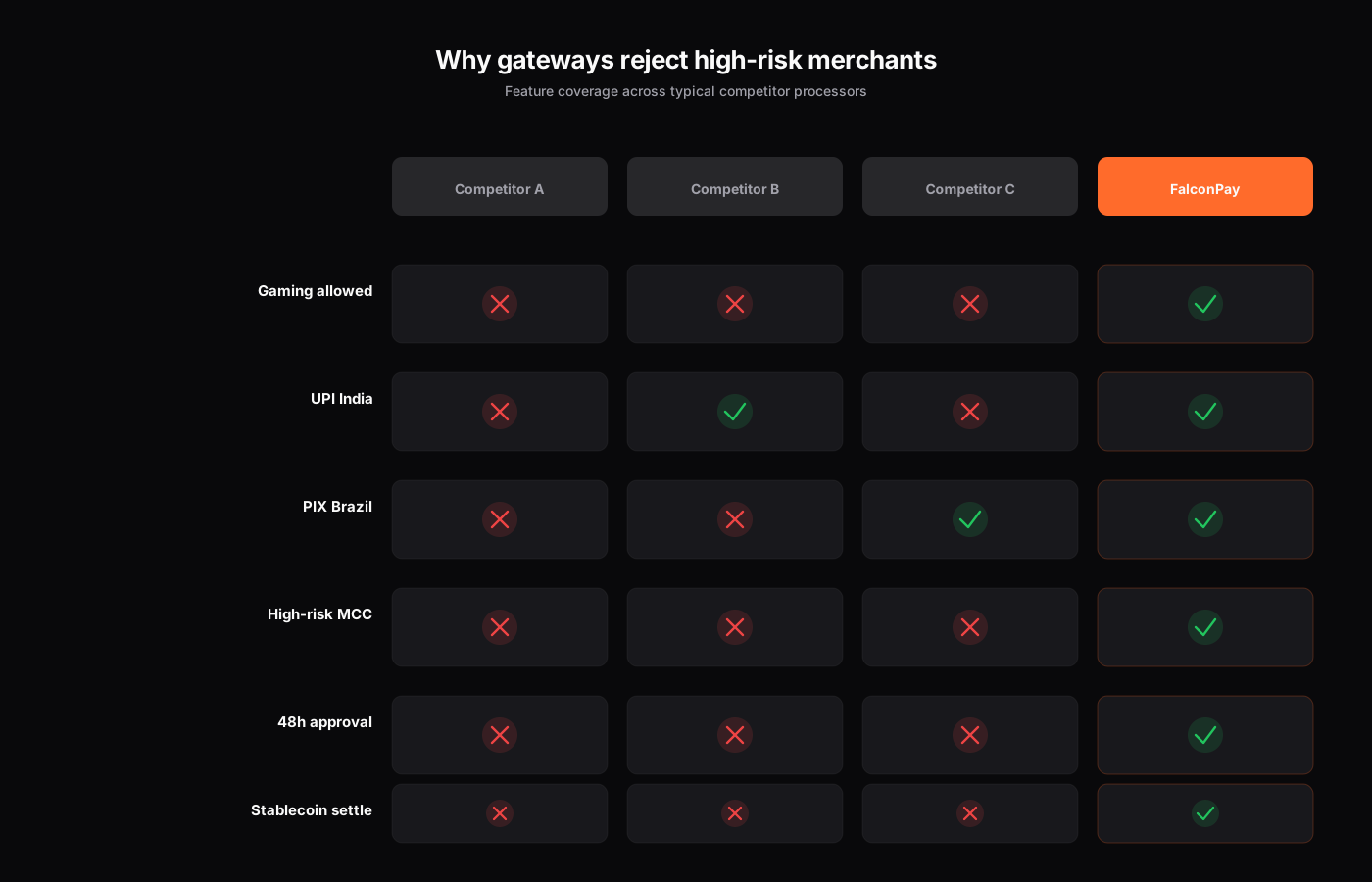
The solution is not to find a loophole in mainstream processors. It's to use infrastructure built for this category. Here is how the options compare:
| Processor | Gaming Approved | India UPI | SEPA | PIX | Onboarding |
|---|---|---|---|---|---|
| Stripe | No | No | Limited | No | N/A |
| Razorpay | No | Yes | No | No | N/A |
| PayPal | Limited | No | Limited | No | Weeks–months |
| Nuvei | Limited | Limited | Yes | Limited | 2–4 weeks |
| FalconPay | Yes | Yes, 98.5% | Yes | Yes | 48 hours |
For operators who need UPI in India, SEPA in Europe, and PIX in Brazil from a single integration, with a processor that genuinely understands gaming risk, the options narrow quickly. FalconPay's iGaming payment gateway was built as the answer to exactly this problem.
For a detailed comparison of specialist processors, see PayKings alternatives for iGaming and our guide to high-risk payment processing.
Rejected by Stripe, PayPal, or Razorpay?
FalconPay approves gaming merchants in 48 hours. UPI, SEPA, PIX, and cards, from a single integration built for high-risk operators.
Apply for Gaming Merchant Account →Frequently Asked Questions
Can I use Stripe for an online casino?
No. Stripe's restricted businesses policy explicitly prohibits online casinos and gambling transactions globally, with no exceptions regardless of licensing or jurisdiction. Any account found processing gambling transactions will be terminated with funds held for 90–180 days.
Does Razorpay accept gaming merchants in India?
No. Razorpay withdrew from iGaming and fantasy sports verticals in 2025 following RBI regulatory pressure. As of 2026, Razorpay does not process payments for Indian gaming or gambling platforms. Cashfree and PayU made the same exit on a similar timeline.
Can I use PayPal for gambling transactions?
PayPal permits gambling transactions only in specific regulated markets (UK, France, Germany) for operators with the appropriate national licence. For Indian, Brazilian, or US gaming operators, PayPal is not available. Even where permitted, PayPal accounts for gaming can be restricted without notice.
What happens when a gaming merchant account is closed?
Your processing stops immediately. Funds are held for 90–180 days to cover chargebacks. If you misrepresented your business category during onboarding, you may be added to the MATCH list which prevents approval by mainstream processors for up to 5 years.
What documents does a gaming merchant need to get approved?
At minimum: certificate of incorporation, proof of identity for beneficial owners, 3–6 months of bank statements, and a website with clear terms of service. A gaming licence or licence application significantly accelerates approval. A documented AML/KYC policy and responsible gambling policy are strongly recommended.
How do I switch payment processors without gaming downtime?
Apply to your new processor before you need to switch. Integrate in parallel while your existing processor is live. Route 5–10% shadow traffic to test the new integration on live transactions. Cut over 100% once verified. Keep the old account open for 90 days until all chargeback windows clear.
Which payment gateway actually approves high-risk gaming merchants instantly?
Specialist processors like FalconPay are built specifically for gaming merchants and can approve accounts in 48 hours. Unlike mainstream processors, they have dedicated acquiring bank relationships for gaming merchant categories and understand gaming-specific chargeback patterns.