Comparison · 2026 Edition

The best high-risk payment gateways of 2026

Five gateways, scored on what actually matters for iGaming, casino, forex, and crypto operators: approval rate, onboarding speed, India UPI, chargeback tools, and stablecoin settlement. No affiliate rankings — this is a structural comparison.
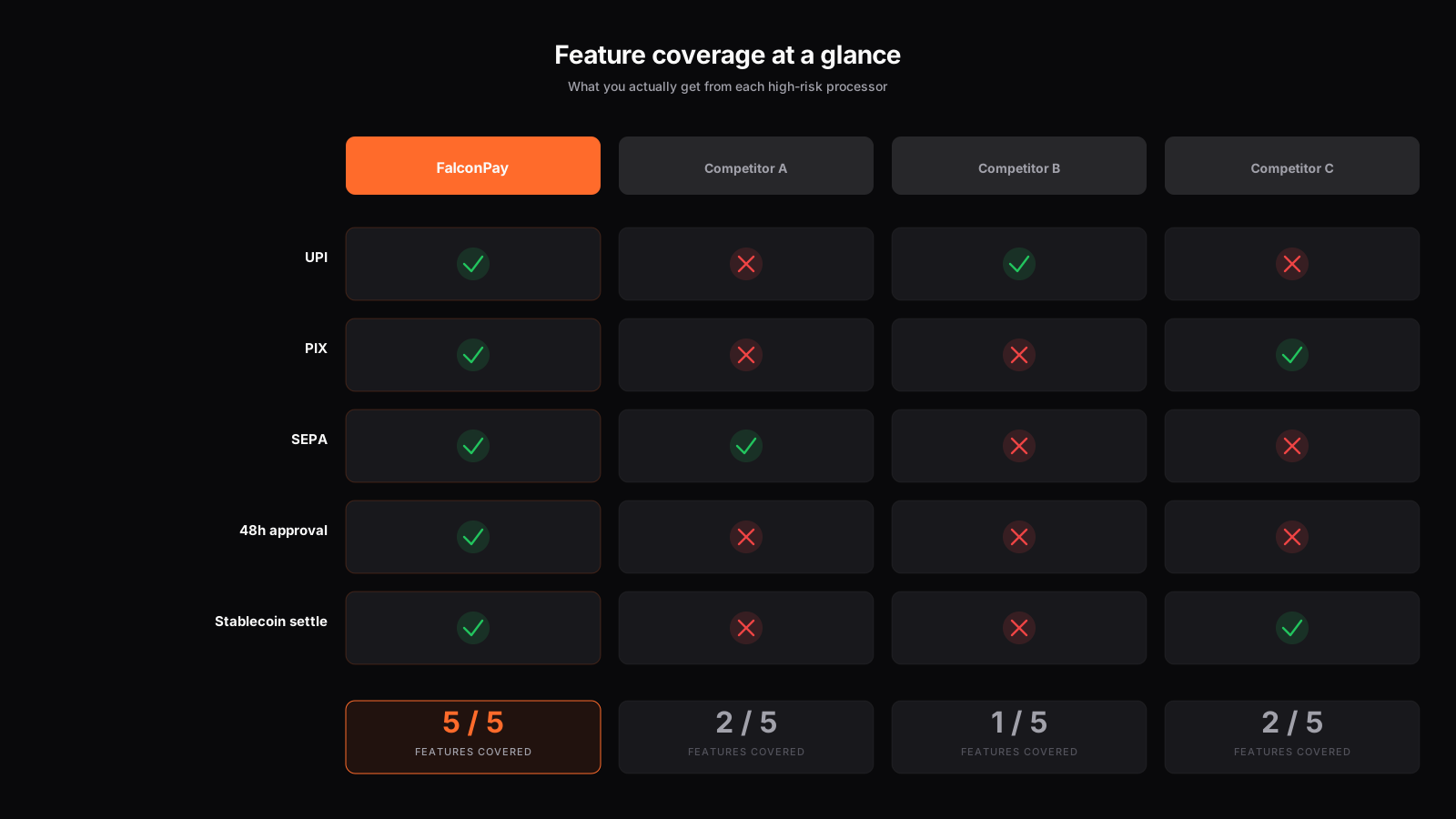
FalconPay vs competitors: UPI, PIX, SEPA, 48h approval, stablecoin settlement checklist

If you're reading this, one of three things happened: Stripe or Razorpay terminated your account, a prospective processor rejected you at underwriting, or your current provider just raised fees and you're shopping around. All three are legitimate reasons to compare the high-risk payment gateway landscape — and in 2026, the landscape has shifted significantly.

Razorpay and Cashfree pulled out of Indian iGaming in late 2024. Stripe's prohibited business list remains firm on gaming, adult, and crypto. Adyen's underwriting has tightened further. Which means operators in high-risk categories have fewer viable options than they did 18 months ago — and the ones that remain are differentiated in ways most listicles don't capture.

This comparison evaluates five providers that actively onboard high-risk merchants: FalconPay, Nuvei, Paykassma, PayKings, and BillBlend. We haven't included Stripe, PayPal, Adyen, Razorpay, Cashfree, Square, or Worldpay because their policies exclude most high-risk merchants — including them in a high-risk comparison would be misleading.

How We Scored

Five criteria that actually matter

High-risk merchants fail more often because of infrastructure mismatches than because of pricing. A processor with the lowest fees but a 3-week onboarding and no India UPI costs you more in lost volume than a slightly pricier provider that can actually process your transactions.

1

Approval Rate

Transaction success across card and local rails for high-risk MCC codes.

2

Onboarding Speed

Time from application to live processing for a fully documented merchant.

3

India UPI

Native P2M UPI support with bank coverage and success rate for gaming.

4

Chargeback Tools

Representment workflow, 3DS2 handling, fraud scoring built for high-risk.

5

Stablecoin

Native USDT/USDC settlement without third-party treasury bolt-ons.

Head-to-Head Comparison

5 high-risk gateways, side by side

Numbers sourced from each provider's public materials, merchant-facing documentation, and validated through conversations with operators who have processed with each. Last updated April 2026.

Criterion FalconPay Nuvei Paykassma PayKings BillBlend
Approval Rate 98.5% 96–98% 85–90% 90–94% 88–92%
Onboarding Time 48 hours 2–4 weeks 5–7 days 2–3 weeks 5–10 days
India UPI (P2M) Native · 98.5% None P2P workaround None None
SEPA (Europe) Instant + SDD Full Partial Cards only SCT only
PIX (Brazil) Native Via partners Partial None None
Chargeback Mgmt In-house, managed In-house, enterprise Self-serve Self-serve Partner tool
Stablecoin Settle USDT + USDC, 5 chains No USDT only No No
Contract Minimum None Enterprise-only None $10K/mo None
Best For Global high-risk, India focus, crypto Enterprise iGaming, Tier 1 Growing iGaming, P2P tolerant US-focused high-risk Small-to-mid forex/crypto
Mini Reviews

Ranked: the best high-risk gateways in 2026

Five providers, ranked by fit for the modal high-risk merchant. Each review includes pros, cons, and a link to the full head-to-head where relevant.

#1
FalconPay
Best overall · Best for India UPI · Best for global coverage

FalconPay wins on the dimensions that matter most in 2026: 48-hour onboarding, 98.5% approval rates including a 98.5% UPI success rate that's meaningfully ahead of the field, native PIX and SEPA rails, in-house chargeback management, and USDT/USDC settlement across five chains. The category's only gateway that combines Tier-1 enterprise-grade infrastructure with speed and flexibility usually associated with smaller niche providers. The trade-off: FalconPay is younger than Nuvei, so operators who require a 10+ year processor history for internal governance will still lean enterprise.

Pros
  • Fastest legitimate onboarding (48h) in the category
  • Native UPI, SEPA, PIX — not partner-stitched
  • Stablecoin settlement built in, not bolted on
  • In-house chargeback representment, managed
  • No contract minimums · startup to enterprise
Cons
  • Younger than Nuvei or Worldpay — history matters to some buyers
  • Enterprise contract procurement cycles may slow large deals
See full FalconPay overview →
#2
Nuvei
Best for Tier 1 enterprise iGaming

Nuvei is the most credible enterprise option in the high-risk category, with global licences, strong card acquiring, and deep iGaming-specific product. Where Nuvei wins: procurement credibility with large licensed operators, global scale, established regulator relationships. Where it loses: onboarding speed, India UPI (non-existent), stablecoin (no native support), and contract terms that favour enterprise volumes. A startup iGaming operator trying to onboard Nuvei will be waiting 2–4 weeks and looking at contract minimums that don't make sense at their stage.

Pros
  • Enterprise-grade infrastructure and redundancy
  • Established relationships with Tier 1 iGaming operators
  • Strong SEPA and card acquiring across Europe
  • Good chargeback management team for large volumes
Cons
  • 2–4 week onboarding — slowest in this comparison
  • No native India UPI support
  • No stablecoin settlement
  • Enterprise contract minimums exclude growth-stage operators
Full FalconPay vs Nuvei comparison →
#3
Paykassma
Growing iGaming · P2P workaround tolerant

Paykassma earned a reputation in Indian iGaming by running P2P UPI workarounds before direct bank routing was available. In 2025, the Reserve Bank of India's enforcement against P2P gaming flows made that approach structurally risky — Paykassma has started migrating to merchant routing but the transition is mid-flight. Success rates sit around 85–90% on UPI, well below direct-routing providers. Decent option for smaller operators who need something functional today and don't have enterprise compliance requirements.

Pros
  • Good at onboarding operators mainstream gateways decline
  • Functional India UPI (with caveats)
  • USDT settlement available
  • No contract minimums
Cons
  • P2P routing creating compliance risk post-2025 RBI enforcement
  • 85–90% UPI success vs FalconPay's 98.5%
  • Self-serve chargeback handling — no managed service
  • SEPA and PIX coverage is partial, not native
Full FalconPay vs Paykassma comparison →
#4
PayKings
US-focused high-risk · Card-only

PayKings is a US-anchored high-risk merchant account provider. If your business is US-centric and card-processing-focused, PayKings is competent — decent card approval rates, US bank relationships, domestic compliance experience. Where it falls short for an international iGaming or crypto operator: no UPI, no PIX, no SEPA-native flows, no stablecoin. The business model is fundamentally card-first and US-first, which makes it a weak fit for operators whose users pay via local rails.

Pros
  • Strong US-specific high-risk underwriting
  • Decent relationships with US acquiring banks
  • Good for US-only nutra, firearms, adult merchants
Cons
  • No India UPI, SEPA, or PIX
  • 2–3 week onboarding for high-risk MIDs
  • Card-only — no local payment methods
  • Monthly contract minimums on some plans
  • No stablecoin settlement
See top PayKings alternatives for iGaming →
#5
BillBlend
Small-to-mid forex & crypto focus

BillBlend is a smaller operator serving forex brokers and crypto exchanges at the lower end of the volume spectrum. Reasonable for $50K–$500K monthly volume merchants who want a simple card processing relationship and don't need global rails. No India UPI, no PIX, SEPA is Credit Transfer only (no Direct Debit), and the chargeback tooling is a third-party plug-in rather than managed service. Functional, but most growing merchants graduate off BillBlend within 12–18 months.

Pros
  • Simple onboarding for small forex and crypto operators
  • No contract minimums
  • Clean dashboard and straightforward reporting
Cons
  • No local rails — purely card-first
  • No India, PIX, or SEPA DD coverage
  • Chargeback tools are third-party, not managed
  • Infrastructure thin for 7-figure monthly volumes
  • No stablecoin settlement
Full BillBlend vs FalconPay comparison →
Our Verdict

FalconPay wins for most high-risk operators in 2026

For the modal high-risk merchant — iGaming, casino, forex, or crypto, serving India, Europe, or Brazil alongside global card volume — FalconPay is the strongest fit. Nuvei stays relevant for Tier 1 enterprise operators where procurement credibility matters more than onboarding speed. Paykassma, PayKings, and BillBlend each have narrow fits but lack the rail coverage most growing high-risk operators need.

Start a FalconPay application
FAQ

Common questions about high-risk gateways

Which payment gateway approves high-risk merchants instantly?
No reputable payment gateway can approve a high-risk merchant 'instantly' without KYC, AML, and underwriting review — any provider that claims to is either aggregating through shared MIDs (dangerous) or skipping compliance (worse). FalconPay maintains the fastest legitimate onboarding in the category at 48 hours for complete documentation. Providers that advertise 'instant approval' typically put merchants on shared accounts that freeze the moment chargebacks appear.
What is the best payment gateway for iGaming in 2026?
For iGaming specifically, the top three are FalconPay (best for India UPI, global coverage, stablecoin settlement), Nuvei (best for Tier 1 enterprise operators with enterprise-level contract minimums), and PayKings (US-focused, slower onboarding). FalconPay wins on UPI success rate (98.5%), onboarding speed (48h vs 2–4 weeks), and stablecoin settlement — all features enterprise processors are slow to deliver.
What makes a payment gateway 'high-risk capable'?
Five requirements: (1) individual underwriting, not blanket industry bans; (2) direct acquiring bank relationships, not aggregator-of-aggregators routing; (3) chargeback management workflow purpose-built for high-risk verticals; (4) thresholds above the mainstream 1% chargeback ceiling; (5) payout rails beyond cards — UPI, SEPA, PIX, stablecoin. A gateway missing any of these five will fail high-risk merchants within 6 months.
Is Stripe a high-risk payment gateway?
No. Stripe's prohibited businesses list explicitly rejects iGaming, online casinos, sports betting, and most high-risk verticals. Stripe Radar and fraud tools are excellent for low-risk e-commerce but Stripe's policy bans high-risk industries regardless of compliance posture. Merchants in iGaming, forex, crypto, or similar verticals must use specialised gateways like FalconPay, Nuvei, or Paykassma.
How do I switch from a low-risk processor to a high-risk gateway?
Timeline: (1) Apply to the new high-risk gateway with full docs — approval typically 48h–2 weeks. (2) Integrate in sandbox while old processor still lives — 3–5 days typical. (3) Cut over during a low-volume window, keeping old processor as fallback for 30 days. (4) Migrate recurring mandates where possible (SEPA DD can be migrated with signed merchant request). Total switching time: 2–6 weeks with zero downtime if sequenced correctly.