The merchant
An MGA-licensed online casino operator incorporated in Malta, operating in 14 European markets. At migration time:
- €8.5M/month in gross deposit volume, roughly 70% card and 30% local payment methods
- MGA Class 1 remote gaming licence, with local registrations across secondary markets
- Structure: one MGA licensee entity, three sub-entities in separate EU markets, shared tech stack and player wallet
- Prior processor: Nuvei for cards and SEPA, with additional local payment method integrations via third parties
The operator was not a new, small merchant in difficulty — they were a grown-up, compliant, seven-figure-a-month business that had outgrown their processor's ability to flex with them.
The problem: enterprise stack, enterprise friction
Three specific pain points drove the migration decision, and they are common across the Nuvei / Worldpay / Adyen segment for iGaming operators at this scale:
1. Card approval plateau at 94.3%. Nuvei was routing all card traffic through a single primary acquirer. Smart routing was marketed but in practice meant a fallback acquirer that handled <10% of traffic. For an iGaming operator where BIN ranges, issuer country mix, and 3DS2 exemption eligibility vary dramatically by market, single-acquirer routing caps approval rates well below what the underlying traffic supports.
2. SEPA creditor ID as a blocker. Nuvei's standard SEPA Direct Debit setup required the operator to apply for its own SEPA creditor ID (CID) and have it linked to the Nuvei facility. That application, routed through the merchant's acquiring bank, took 11 weeks. Three months of no SDD collection during which the operator was stuck with card-only inbound in markets where SEPA DD would have been the strongly preferred player flow.
3. Sub-entity re-underwriting. Every time the operator launched a new sub-entity for a new market (regulatory requirement in some EU jurisdictions), Nuvei required the sub-entity to go through a fresh underwriting cycle. Average time: 6 weeks. For a group rolling out a new market every 6–9 months, that's 30–40% of each market's year-one revenue lost to processor onboarding latency.
On top of this: an increasing volume minimum of €500K/month (per entity), and a contract renewal discussion where the operator's desired changes — faster new-entity turnaround, multi-acquirer card routing — were communicated as "not standard for your tier."
"Nuvei was stable, but stable isn't the same as good. We were sitting at 94.3% card approval and we could see exactly where the missing 5% was — it was BIN ranges that our primary acquirer routinely declined that another acquirer would approve. We asked for multi-path routing and were told it would be considered in the next contract cycle. Meanwhile we were leaking close to €400K a month in declined transactions we could fix with a config change."
The migration plan
Unlike a scrappy merchant firefighting an outage, this operator had the luxury of planning. The migration was designed to keep Nuvei live for a minimum of 60 days post-cutover — belt and braces.
Why the card approval lift happened
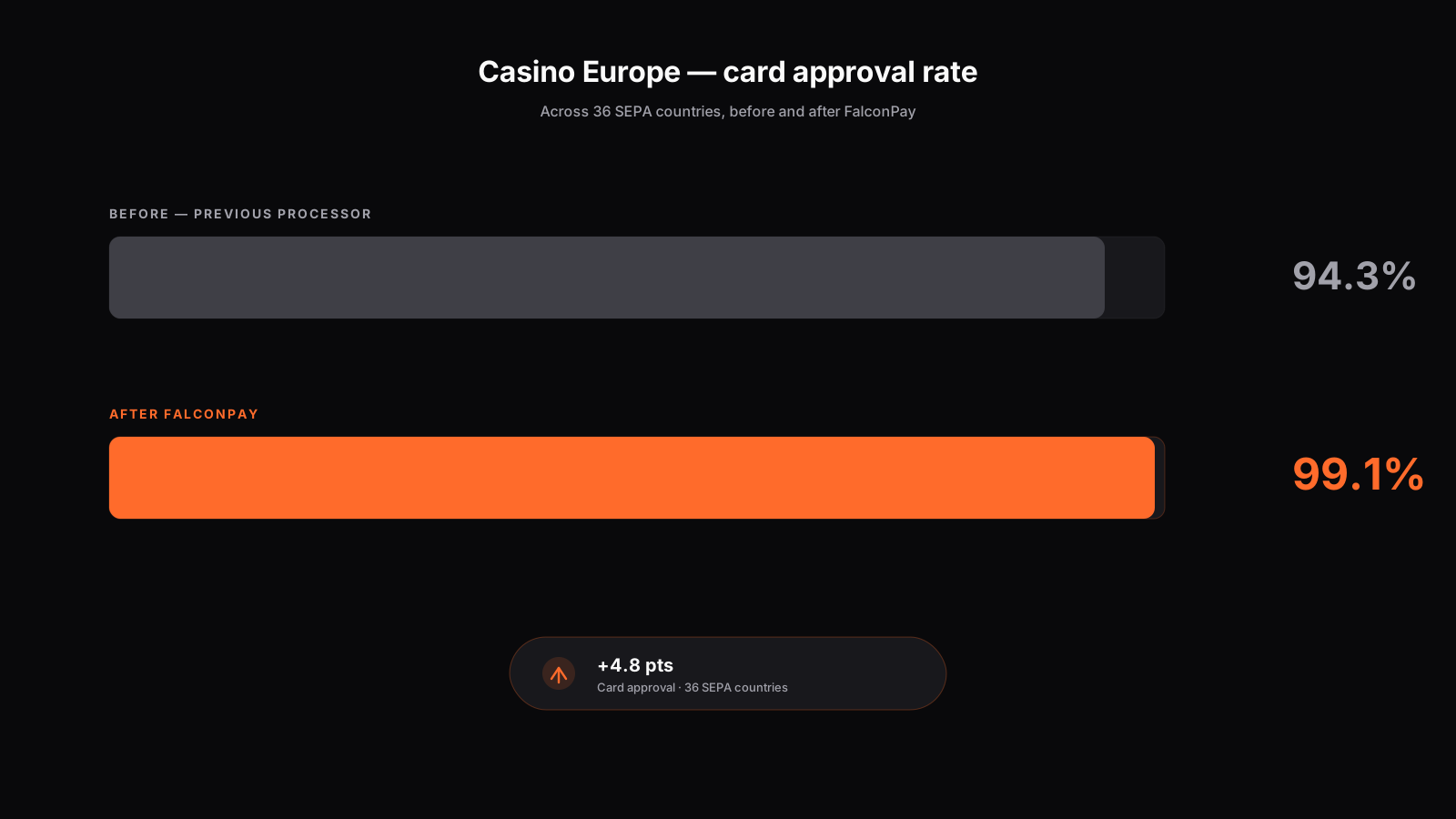
The 94.3% → 99.1% card approval lift wasn't a single trick. It was the compound effect of four independently meaningful changes, each worth 1–2 percentage points.
Multi-acquirer BIN-range routing. FalconPay runs three card acquirers across the EU. Each acquirer has different issuer relationships — some approve certain BIN ranges at 98%, others at 88%. Routing each card transaction to its optimally-matched acquirer, based on the BIN, lifted approval on ~18% of volume by 4–7 percentage points.
3DS2 exemption optimisation. PSD2 allows exemptions from Strong Customer Authentication for low-risk transactions (TRA exemption) up to €500. Nuvei was applying 3DS2 to nearly all transactions, adding authentication friction that caused drop-off. FalconPay's router requests exemption where the transaction profile qualifies — keeping 3DS2 for risky transactions, removing it for low-risk ones.
Soft-decline retry logic. Some card declines are "soft" — issuer is temporarily rate-limiting, or the transaction was flagged but not hard-declined. FalconPay automatically retries soft declines through an alternate acquirer within 400ms, recovering transactions that would otherwise appear as a customer-facing failure.
Currency presentation. For cross-border transactions, presenting the transaction in the cardholder's billing currency rather than the merchant's base currency improves approval rates because issuers look for mismatched-currency signals as fraud indicators. FalconPay handles dynamic currency presentation automatically.
Combined, these four changes took the operator's card approval from 94.3% to 99.1% over the 90 days post-cutover. Of these, BIN-range routing contributed the largest share.
SEPA: why 8 days instead of 11 weeks
The 11-week SEPA creditor ID timeline was a structural artefact of Nuvei's setup — they required operators to hold their own SEPA CID. FalconPay operates as the SEPA creditor of record, with merchants onboarded as underlying service providers. This means:
- No SEPA CID application from the merchant's acquiring bank
- No IBAN-level setup for each sub-entity — they inherit the group's SEPA setup
- SEPA Direct Debit mandates can be issued on day 1, not week 12
- SEPA Credit Transfer payouts available immediately
For this operator, that collapsed the SEPA rollout from 11 weeks to 8 days. The 8 days were mostly spent on mandate migration workflow for the recurring SDD mandates already in place at Nuvei — coordinated via a signed merchant letter of authorisation, with the actual mandate data transfer completing over a weekend.
Chargeback rate: 1.2% → 0.38%
The operator had been sitting at 1.2% card chargeback rate on Nuvei, past Visa's 0.9% warning threshold and approaching the 1.8% excessive threshold that triggers VDMP. They were one bad month from being enrolled in Visa's Dispute Monitoring Programme — which would have meant monthly per-dispute fees on top of the volume of disputes themselves.
Post-migration, three changes drove the rate from 1.2% to 0.38% within 60 days:
- 3DS2 liability shift. With 3DS2 on transactions that needed it, fraud-related chargebacks (roughly 40% of the operator's disputes) started resolving in the operator's favour because liability shifted to issuer.
- Velocity rules tuned for iGaming. FalconPay's velocity engine is pre-tuned for iGaming deposit patterns. Unusual multi-card testing, rapid-fire deposits from new cards, and VPN-exit-IP mismatches all got flagged at the pre-authorisation layer.
- In-house representment. FalconPay's chargeback team handles representment in-house using pre-built evidence templates per reason code — game logs showing funds were wagered, IP/device fingerprint proof, KYC documentation, T&C acceptance. The operator went from losing roughly 60% of disputable chargebacks to winning roughly 70%.
Before and after
Results — 90 days post-migration
Measured Outcomes
When enterprise processors are still the right choice
Migrating off Nuvei was right for this operator. It is not right for every operator at €8M/month.
Cases where enterprise processors like Nuvei remain the right fit:
- Operator's internal governance or procurement policy mandates vendors with 10+ years of operating history and a specific set of certifications that younger processors haven't yet had time to accumulate (e.g., local jurisdictional audit histories).
- Operator is part of a larger public group where vendor selection is centralised and newer providers face structural blockers.
- Operator requires specific in-country acquiring presence (e.g., direct Tier 1 US acquiring bank relationships) that a younger provider doesn't have yet.
For this operator, none of those conditions applied. Compliance and infrastructure credibility were more than adequate on FalconPay, and the operational wins were too large to ignore. For operators evaluating this decision, it's worth being honest about which of the above (if any) actually apply, rather than defaulting to "enterprise is always safer."
Outgrown your current EU processor?
If you're running an MGA, UKGC, Curaçao, or Estonia-licensed iGaming operation across Europe and running into card approval ceilings, SEPA setup delays, or sub-entity friction, we can run a similar BIN-decline analysis on your current 90 days of data.
Request a decline analysis