The merchant
A fantasy sports operator launched in late 2025, positioned as skill-based gaming and operating in both India (post the 2025 fantasy sports regulatory framework) and Brazil (post the 2024–2025 regulated sports betting / fantasy landscape opening up). At the point of payment infrastructure scoping:
- Pre-launch planning phase — payment stack needed to be live before soft launch
- India: registered Indian entity, GST-compliant, skill-gaming structured, TDS workflow ready
- Brazil: Brazilian corporate entity, CNPJ registered, operating under the late-2024 regulated framework
- Target launch volumes: ₹15–20Cr/month India, R$2–3M/month Brazil (year-one projection)
- Target players: cricket and football fantasy in India, futebol and UFC fantasy in Brazil
The problem most dual-market operators don't plan for
Most fantasy sports operators that are active in multiple markets got there by sequential expansion — launched India first, figured out that stack, then expanded to Brazil a year later with a separate processor and a separate team managing it. Over time that becomes a set of parallel payment silos that share nothing.
This operator had the opportunity to do something different: launch both markets at once, but only if they could find a single provider who could actually stand up PIX and UPI together, under one MID, with shared reconciliation. That requirement knocked out most of the market:
- Indian processors typically have no Brazil capability at all.
- Brazilian processors typically have no India UPI capability.
- Large global processors like Nuvei or Worldpay have SEPA and cards but weak India UPI and partner-stitched PIX.
- Aggregators claiming both markets usually route one of them through a third party with weak operational SLAs.
"We wanted to launch two markets in parallel, not in series. But every processor we spoke to could do one well and the other badly. We were on the verge of accepting that the Brazil launch would be three months behind India, with separate tooling, separate reconciliation, and double the operations surface area — until FalconPay's pitch was 'we handle both, one MID, one dashboard.' We asked them to prove it. They did."
What "dual-rail from day one" actually means technically
Three things make a processor genuinely capable of running dual-market PIX and UPI under one integration, vs. the common setup where it looks like one integration but is actually two bolted together under a thin wrapper:
1. Single MID architecture. One merchant identification account that covers both markets. Not two MIDs stitched by the portal. This matters because it means one KYC/AML review, one underwriting profile, one contract — not a separate onboarding cycle per country.
2. Shared API surface. The same POST /v1/payin endpoint initiates both an India UPI and a Brazil PIX deposit, differentiated by a country and method parameter. Reconciliation, webhooks, and settlement reports use the same shapes with the same field names. The merchant's engineering team does not have to write two parallel integrations.
3. Consolidated settlement. India INR volumes and Brazil BRL volumes land in the merchant's treasury through a single settlement configuration — either direct-to-fiat in local currency, or consolidated through USDT stablecoin for treasury centralisation. For this operator, the USDT daily consolidation route was the right answer: a Brazilian BRL sale at 2pm IST and an Indian INR deposit at 3pm IST both settle to the same USDT wallet within 24 hours, with clean transaction metadata.
The architecture that actually got built
🇮🇳 India
Bank-direct UPI P2M routing across 3 acquiring banks. Intent flow on mobile for 95%+ success rate on mobile deposits. Settlement options: T+1 INR or daily USDT.
- UPI Intent + Collect smart selection
- 3-bank routing with automated failover
- GST invoicing on platform fees
- 30% TDS reporting workflow for winnings
- State-permission compliance hooks
🇧🇷 Brazil
PIX instant deposits 24/7 via direct integration with Brazilian banks. CPF validation on every transaction. Boleto for cash-flow-led deposits. Settlement: T+1 BRL or daily USDT.
- PIX instant deposits with QR + copy-paste
- CPF + full-name match required
- Boleto issuance with 3-day expiry window
- Portuguese-localised deposit UI
- Sub-R$500 auto-approval, above manual review
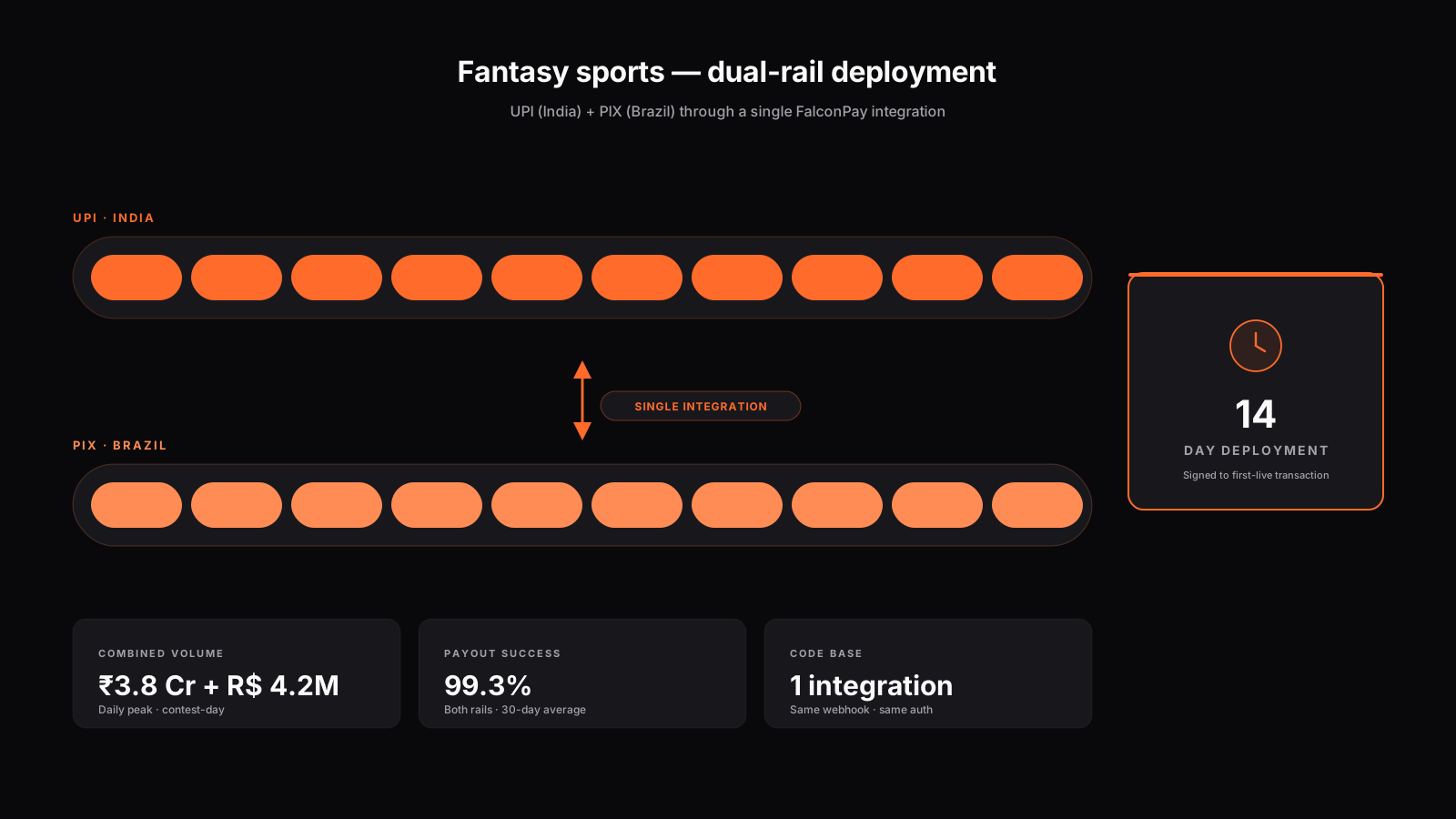
Both markets sit behind a single merchant dashboard. The operator's finance team runs a single weekly reconciliation export — not one for India and one for Brazil. Their fraud team has a single rules console that can apply market-specific policies without managing two separate tools.
14-day launch timeline
The operator signed on a Monday. Indian regulatory registration for UPI merchant handles runs independently of Brazilian PIX setup, so the two tracks ran in parallel from day one.
POST /v1/payin endpoint handling both UPI and PIX. Webhook signatures tested. Reconciliation schema validated.Time from signed contract to both markets processing real player deposits: 14 days. For reference, a sequential India-first-then-Brazil launch with separate processors would typically have taken 3–4 months to reach the same state.
Why single-integration matters operationally
Standing up two markets on a single MID isn't just a technical convenience. It has measurable operational consequences — especially for a new operator where every hour of ops time is scarce.
The operator's internal estimate: a dual-processor setup would have consumed ~25–30 hours/week of ops time across finance, engineering, and support. On FalconPay, that falls to 5–7 hours/week. That's roughly one full-time-equivalent of ops capacity reallocated to other work.
USDT 24-hour settlement: why this mattered for a new operator
For a new operator just ramping up, cash-flow visibility is critical. Traditional T+2 or T+3 fiat settlement across two currencies (INR and BRL) makes cash-flow modelling noisy — you're reconciling across two banking days, two currencies, and two settlement pipelines.
The operator opted for USDT daily settlement across both markets. Every 24 hours, net deposits (minus net payouts, minus fees) from both India and Brazil convert to USDT and land in a single stablecoin treasury wallet. Their finance team runs a single daily treasury check, not two.
Side benefits that showed up in practice:
- FX exposure on INR and BRL reduced to 24-hour rolling window instead of 3-day
- Cross-market treasury reallocation (e.g., funding Brazil payouts from India deposits) happens on-chain, not via slow international wire
- Ops team didn't need separate INR and BRL treasury accounts running balance reconciliation at all — the consolidated USDT wallet is the source of truth
Results — 90 days post-launch
Measured Outcomes
Regulatory context: what made this viable in both markets
The operator could launch in both markets at the pace described because they had done the regulatory homework before engaging a processor. This is worth making explicit because it's often where dual-market operators stumble.
India — post-2025 fantasy sports framework. The operator structured as a skill-based gaming entity, operating only in states where fantasy sports is permitted, with GST registration, proper TDS deduction on winnings, and a clean AML policy. This is what "compliant Indian fantasy sports" looks like in 2026 — and it is what any payment processor will require before underwriting UPI.
Brazil — post-regulation sports / fantasy landscape. The Brazilian regulatory framework for online betting (including fantasy) opened up in 2024–2025. Operators who have Brazilian corporate registration (CNPJ), comply with the Ministry of Finance / SECAP regulations where applicable, and have local AML and KYC workflows in place can operate legally. This operator had that structure in place before any payment conversation.
Put simply: the payment stack didn't make the regulatory compliance easy — the regulatory compliance made a clean payment stack possible.
For operators planning dual-market fantasy / gaming launches
- Do the regulatory work first. Indian skill-gaming structuring and Brazilian CNPJ + SECAP structuring should be in place before engaging any processor. Processors underwrite the structure as-is.
- Evaluate whether your processor can genuinely do both markets under one MID. "Covers India and Brazil" is marketing. "Single MID, single API, single reconciliation across both" is the thing that actually matters.
- Plan for consolidated settlement from day one. USDT stablecoin settlement isn't a crypto gimmick — for a dual-currency operator, it's the cleanest way to unify treasury.
- Budget launch time honestly. Dual-market in 14 days is fast, but it requires both markets to be regulatory-ready on day one. If one market's regulatory work takes 3 months, that's the bottleneck, not the payment rail.
Planning a dual-market fantasy or gaming launch?
If you're planning simultaneous launches in India + Brazil, India + Europe, or other multi-currency combinations, we can map a single-MID architecture against your regulatory setup and timeline.
Talk to our team