The merchant
A CySEC-regulated forex and CFD brokerage, operating for 6 years, with retail traders concentrated in four regions: India, the EU, Brazil, and Southeast Asia. At migration time:
- $2.1M/month in gross deposit volume
- CySEC regulation (Cyprus) with passporting into EU markets
- MT4/MT5 platform, roughly 18,000 funded accounts, average deposit size ~$500
- Payment stack pre-migration: Stripe (cards, about to be terminated for MCC 6211), one Indian gateway (UPI at 72% success), manual wire transfers for EU, crypto-only for LATAM/SEA
The problem: Stripe's MCC policy collided with growth
Stripe's prohibited businesses list includes "foreign currency exchange, binary options, or other trading in derivatives" under MCC 6211 for retail forex brokers. Until 2024, many forex brokers were operating on Stripe under MCC 5734 (computer software) or 7399 (business services NEC) with the tacit understanding that Stripe's enforcement was inconsistent. That changed in late 2024 when Stripe tightened MCC enforcement, and this broker received a 60-day termination notice.
Separately, the Indian side of the business was underperforming badly. Their local Indian processor was running UPI at roughly 72% success rate — 28% of Indian deposit attempts were failing. On $650K/month of Indian deposit traffic, that was ~$180K/month in failed deposits, most never retried.
And then there were the markets without any coverage at all:
- Brazil: 1,200 funded trader accounts, no PIX, no Boleto, no local cards. Forced to deposit via crypto (USDT to broker wallet). Brazilian client complaints about crypto-only deposits ran at 15–20 tickets/week.
- Southeast Asia: Similar story — Vietnam, Philippines, Indonesia, Thailand traders had no local payment method, only crypto. Broker measured 30% conversion loss from sign-up to first deposit in these markets compared to markets with native rails.
"We had three separate payment problems that were about to collide on the same calendar. Stripe was going away in 60 days. Our India UPI was at 72% success and we had no idea how to fix it without rebuilding. Brazil had no rail at all and we were watching Vietnamese and Indonesian traders drop off the sign-up flow because we couldn't accept their local methods. We needed a single provider who could actually land all four of these in a quarter, not over 18 months."
Why forex is a special kind of high-risk
It's worth being precise about why retail forex specifically is categorised as high-risk, because it affects what a payment provider actually needs to do for a forex operator:
Chargeback asymmetry. In forex, if a trader loses money, some small fraction dispute the deposit with their bank claiming the transaction was unauthorised. Unlike iGaming, where "I played and lost" is usually defensible with game logs, forex disputes hinge on whether the trader understood the risk — easier to argue in the trader's favour. Industry-average chargeback rates for retail forex run 1–2% uncontrolled.
MCC classification. Card networks classify retail forex under MCC 6211, which is explicitly prohibited by many mainstream processors. Getting card acquiring at all requires a processor with direct relationships to acquiring banks willing to underwrite 6211 — a smaller list than most operators realise.
Regulatory fragmentation. A CySEC-licensed operator can passport into the EU, but retail forex is explicitly banned to retail clients in some markets (e.g., strict leverage caps under ESMA), restricted in others, and unregulated in still others. Your payment provider needs to understand where your regulatory cover extends.
Payout speed pressure. Retail forex traders expect to withdraw winnings quickly. Processors that take 3–5 days on EUR/USD payouts create customer complaints and churn. For this broker, payout speed was a direct retention metric.
The architecture
FalconPay consolidated the four-market stack onto a single integration. The architecture that replaced the previous Stripe + local UPI + manual wire + crypto-only patchwork:
All four markets operate under a single FalconPay MID with per-region routing policies. Reconciliation, dispute handling, and settlement run through one dashboard rather than four separate processor portals. Critically, when the broker expanded to Mexico later in the year, the Mexico MXN rail came online under the same MID without a fresh contract or re-underwriting.
21-day rollout: how the sequencing worked
With four markets to stand up, the order matters. FalconPay prioritised them by urgency and player volume — India first (highest volume, worst status quo), Brazil second (completely unserved), EU cards third (Stripe termination deadline looming), SEA rails fourth.
Why the India UPI success rate jumped from 72% to 97.8%
The 72% number the broker was running on is lower than the ~87% Paykassma P2P baseline you see in other Indian case studies — which is notable and worth explaining. Three factors dragged their legacy processor's success rate below the already-low P2P baseline:
Forex-specific transaction tagging. The legacy processor's fraud rules were tuned for e-commerce. Forex deposits with typical patterns (repeated round-amount deposits, same-card multi-time-of-day, rapid top-ups) triggered fraud-score declines. FalconPay's rules are pre-tuned for forex deposit patterns so those aren't flagged as false positives.
Bank coverage gaps. The legacy processor had UPI handles on two acquiring banks. For Indian customers banking with banks outside those two, success rates dropped to 50–60%. FalconPay's three-bank routing covered the full mainstream bank spectrum.
UPI Intent vs Collect. The legacy processor used UPI Collect only. Forex traders tend to transact on mobile. Switching default to Intent flow on mobile alone moved the dial by 5–7 percentage points.
Post-migration, Indian UPI success steadied at 97.8% across a full quarter of measured traffic.
Brazil: from zero to 1,200+ funded accounts activated
Brazil was the market where the conversion impact was most visible. Before FalconPay, Brazilian traders signed up, hit the deposit page, were presented with crypto-only options, and 30% dropped off within that flow. After PIX went live:
- First Brazilian deposit via PIX within 48 hours of the rail going live
- 1,200+ existing Brazilian funded accounts reactivated deposits within 30 days (many had been dormant specifically because of the crypto-only friction)
- Brazilian sign-up to first-deposit conversion lifted from 42% to 71% over 90 days
- Boleto accounted for ~15% of Brazilian deposits — traders with no card, depositing cash at ATMs, a segment that simply could not be served before
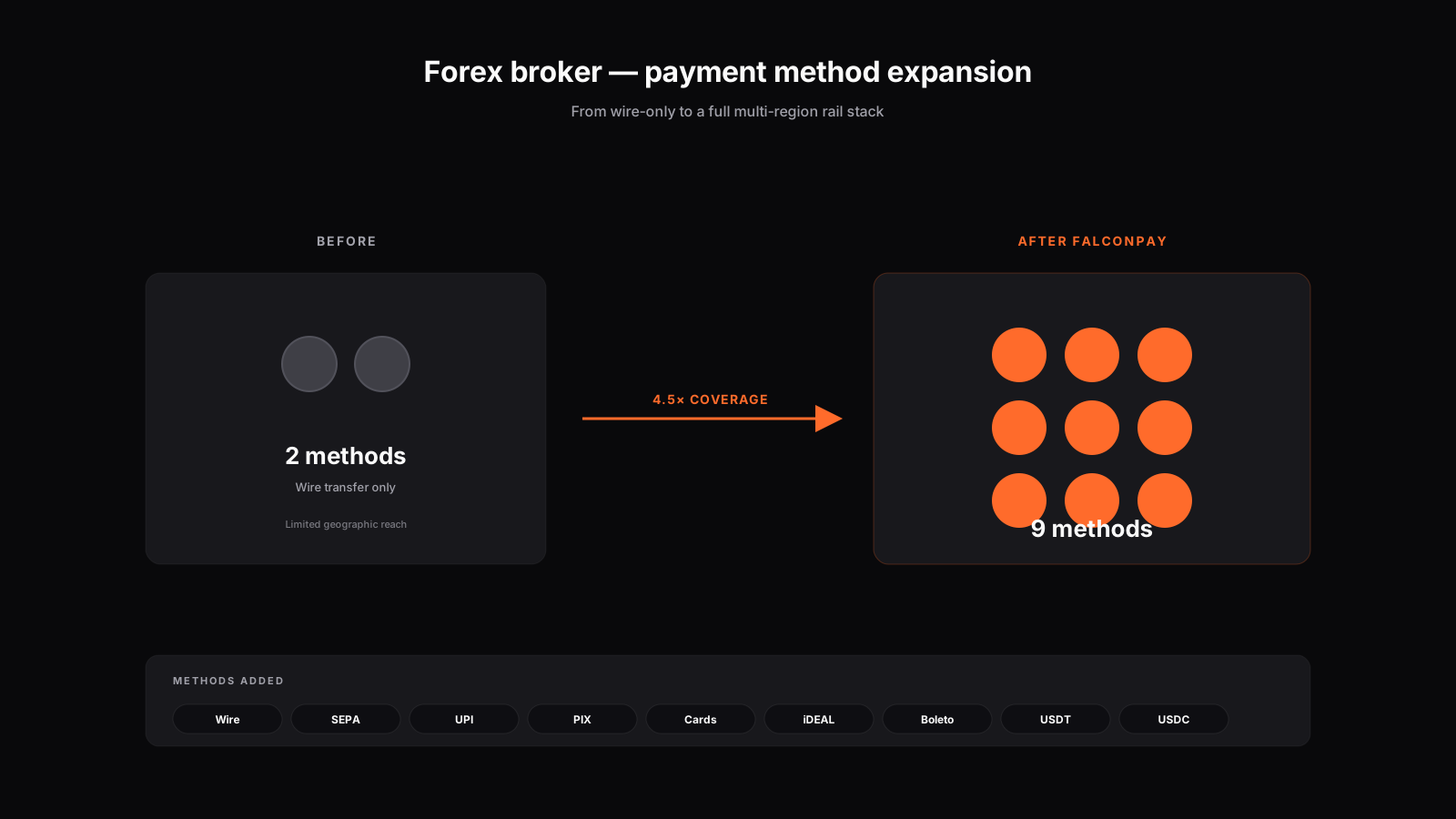
Before and after
Results — 60 days post-migration
Measured Outcomes
For other forex brokers evaluating their stack
A few decision factors worth considering if you're a CySEC, ASIC, FCA, or offshore-licensed retail forex broker reviewing your payment stack:
- Check your card processor's current MCC enforcement stance. Stripe tightened in late 2024. Square followed. Others may in 2026. If you're processing under a non-forex MCC, that's a clock you can't see.
- Audit your India UPI success rate by bank. If you're on a single-acquirer Indian processor, your bank coverage is probably worse than you think. A bank-by-bank breakdown often reveals you're running at 50–60% on some banks and blended-averaging your way to a misleading headline.
- Map your unserved markets. Every market where traders deposit crypto-only because you don't have local rails is a conversion tax. The size of that tax is usually measurable — sign-up to first-deposit drop-off by region, compared against markets where you have local rails.
- Consolidate the reconciliation layer. Running 3–4 processors isn't a safer setup, it's a slower one. Single-MID consolidation with a provider that can cover all your markets cuts ops time meaningfully.
Running retail forex and need multi-region coverage?
If you're a CySEC, ASIC, FCA, Seychelles, or BVI-licensed forex broker and need to consolidate payment infrastructure across India, EU, Brazil, and other markets, we can map your current stack against what a single-MID setup would look like.
Map my stack