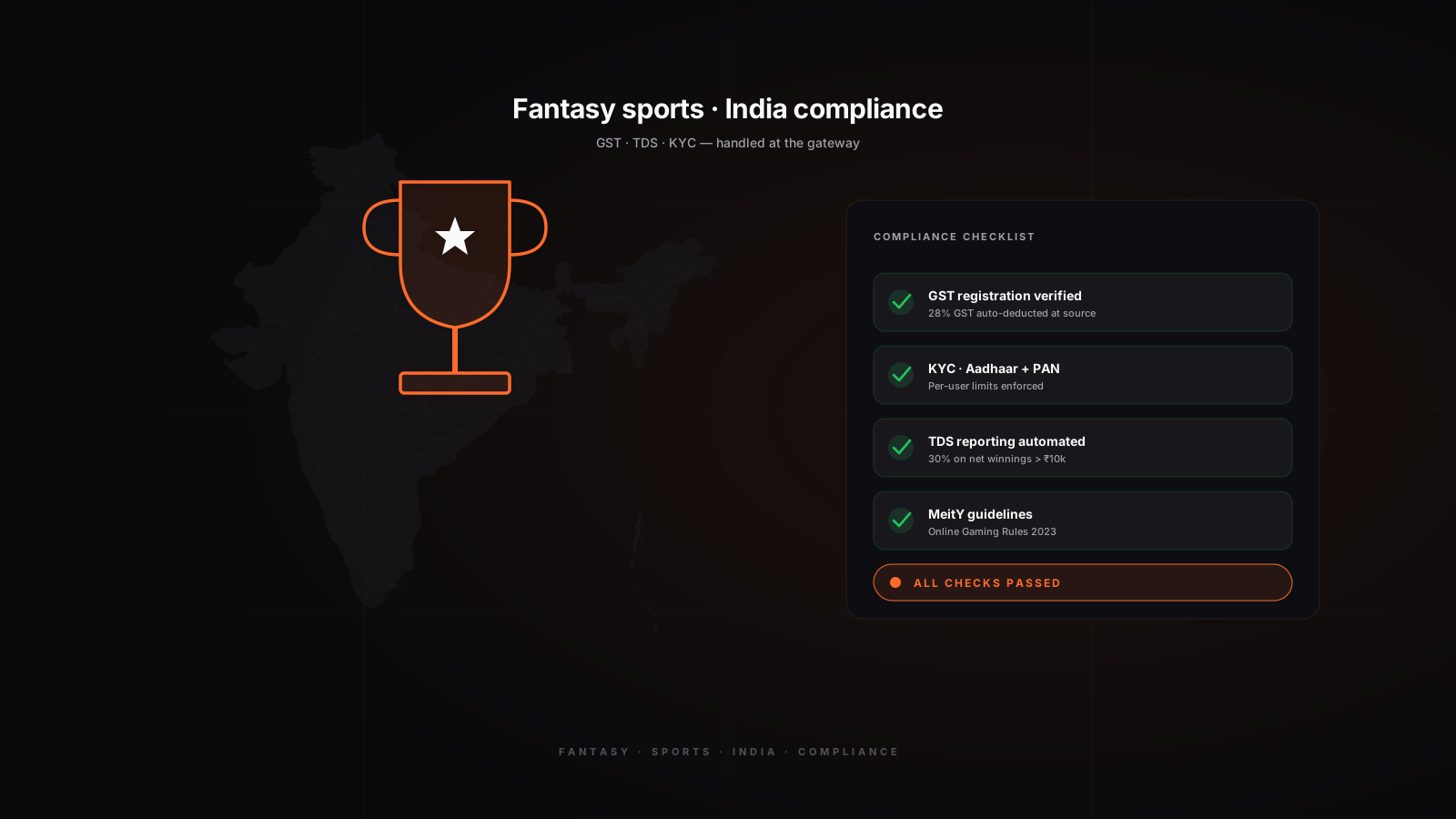
The Post-Regulation Indian Fantasy Sports Landscape
The 2025 regulatory cycle in India did two things for fantasy sports specifically. First, it clarified which operators can legitimately operate. The skill-based gaming category survived, but with tighter structural requirements. Second, it cleared out operators running under ambiguity. A year later, the 2026 picture is that fantasy sports in India is a regulated-but-growing category with a smaller list of legitimate operators and clearer rules for new entrants.
For payment gateway purposes, three things about this matter:
- Skill vs chance distinction is now enforced, not implied. Processors underwrite fantasy sports operators on the basis that they are skill-based gaming. If your product blurs into games of chance, your processor's acquiring bank relationships will not hold.
- Corporate structure is scrutinised. Indian-registered entity, GST-compliant, with TDS workflows operational. Offshore operators targeting Indian players without Indian structure are not underwritable on legitimate Indian rails.
- State permissions are transaction-level, not just licensing-level. If your platform takes deposits from players in states where fantasy sports is prohibited, that's a transaction-level compliance problem your payment layer has to handle.
For the broader context of how we got here, see our earlier post on India gaming payments after the 2025 regulation. This guide focuses on fantasy sports specifically and on the payment infrastructure implications.
State-by-State Legality (What Changed)
Fantasy sports legality in India is state-level. Most states permit it under the skill-based gaming framework; a handful restrict or prohibit it. Operators that accept deposits indiscriminately are taking on compliance risk their processor will eventually catch.
| State | Status | What It Means for Payments |
|---|---|---|
| Maharashtra | Permitted | Standard fantasy sports flows operate normally |
| Karnataka | Permitted | Post-2022 ruling reversal; operations normal |
| Tamil Nadu | Restricted | Narrow restrictions; confirm current state circular |
| Andhra Pradesh | Prohibited | Deposits from AP IPs/addresses should be blocked |
| Telangana | Prohibited | Deposits from TS IPs/addresses should be blocked |
| Odisha | Prohibited | Deposits from OD IPs/addresses should be blocked |
| Assam | Prohibited | Historical prohibition; operations excluded |
| Nagaland | Skill-license framework | Operator-by-operator basis under NGSL framework |
| Sikkim | Permitted (licensed) | Sikkim-licensed operators have specific structure |
| Rest of India | Permitted | Default fantasy sports operation |
Important: State-level fantasy sports regulation evolves frequently. This table reflects the general landscape as of April 2026; always confirm with current state circulars before launching. Operators that rely on stale state permission maps face sudden compliance surprises.
What this means for payment flow design
At the payment layer, state-based restrictions need to be enforced at deposit time. Common mechanisms:
- Player KYC state capture. Player declares residential state during KYC. Deposits from restricted-state KYCs are blocked at the platform layer.
- IP geolocation at deposit. Real-time IP check at deposit time, flagging deposits from restricted-state IPs for review or block.
- Billing-address vs declared-state mismatch flagging. A declared Maharashtra resident depositing from an Andhra IP is worth reviewing: either VPN, travel, or address misreporting.
- Card BIN-level state signals. For card deposits, BIN data sometimes includes geographic signal that can flag mismatches.
GST on Winnings and Platform Fees
The GST framework for fantasy sports has been clarified across 2023–2025 and is settled enough in 2026 to state crisply:
- 28% GST on the full face value of contest entries. Applied at the entry/deposit layer on the amount being staked in contests. This is the headline number operators work with.
- GST on platform fees separately. The platform's commission/rake is subject to GST as a service.
- Invoice issuance. Platforms must issue GST-compliant invoices for contest entries and platform fees.
For payment gateway purposes, the key integration is making sure the deposit/entry flow separates the principal stake from the platform fee at the transaction layer so GST can be calculated correctly. Processors that treat every deposit as an undifferentiated credit to the operator wallet make GST reconciliation painful.
30% TDS on Winnings: What Processors Need to Handle
Per Indian Income Tax rules, operators must deduct 30% TDS on net winnings at withdrawal. This is operator-side withholding, but the payment rails are how it actually gets applied.
How TDS deduction flows through the processor
When a player withdraws winnings, the operator calculates net winnings for the financial year, applies 30% TDS on any amount above the applicable threshold, and issues the payout for the net amount. The processor's role:
- Handle the payout at the net amount. Payout instruction from the operator specifies the after-TDS figure. The processor just executes the payout.
- Transaction metadata for reporting. The processor should tag winnings-payout transactions with enough metadata for the operator's TDS workflow to produce quarterly filings.
- Form 16A-compatible data. Operators need to issue Form 16A to players with TDS deductions, so processor transaction logs should be exportable in a form that supports this.
A processor that can only output generic transaction CSVs forces the operator's finance team to do extra reconciliation work. A processor that outputs tagged, winnings-vs-refund-vs-deposit differentiated transaction data saves days of quarterly filing effort.
UPI P2M: The Only Structurally Safe Model
If there is one thing to internalise from this guide, it is this: in 2026, only UPI P2M (peer-to-merchant) routing is structurally safe for Indian fantasy sports operators. P2P workarounds that worked in 2022–2023 have been systematically cleaned up by the RBI, and operators still routing through P2P intermediaries are on a shrinking timeline.
The three UPI routing models, crisply
P2P (peer-to-peer). Transactions flow from player VPA to a collection of individual bank accounts controlled by the payment provider. Intermediary accounts are not KYC'd as merchants. Under RBI enforcement since late 2024, intermediary P2P accounts are increasingly frozen for gaming flows. This is the model to move away from.
P2M-aggregated. Transactions flow through an aggregator's single merchant account first, then onwards to end merchants. Functional but the aggregator account is a single point of failure and can carry risk from other merchants on the same account.
Bank-direct P2M. The operator is registered as a UPI merchant (P2M) with direct UPI handles per acquiring bank. Transactions flow player → bank → merchant with no intermediary custody layer. This is the legitimate, structurally safe model in 2026.
What bank-direct P2M requires from the operator
- Valid Indian entity registration
- Active GSTIN
- Skill-gaming structuring documented
- AML/KYC policy in place
- Compliance with state permission map (above)
- TDS workflow operational for winnings
Operators with these in place can typically get onboarded to bank-direct P2M routing within 48 hours. Operators missing any of the above, particularly GSTIN or demonstrable skill-gaming structuring, will be declined by legitimate processors, which is the correct outcome.
Concrete read-across: The Bangalore skill-gaming migration case study walks through a real operator moving from P2P to bank-direct P2M routing, recovering ₹4.6Cr/month in failed deposits with zero account freezes in 8 months.
Dream11 and MPL Regulatory Context
Dream11 and MPL are useful reference points because their regulatory exposure shaped how the broader industry is understood. A few relevant points for new operators studying the space:
Skill-vs-chance jurisprudence
Indian jurisprudence on fantasy sports has consistently favoured the "game of skill" classification for well-designed fantasy contests, with the Supreme Court affirming this in rulings around Dream11's operations. For a new operator, this means your product design matters. Contests where outcome is demonstrably skill-dominant fall under the permitted category. Contests that drift into chance-dominant territory don't, regardless of branding.
Advertising and responsible play
Both Dream11 and MPL have been required to adjust advertising practices, particularly around disclaimers, age restrictions, and responsible-play messaging. For new operators, the takeaway is that ad compliance is part of operational compliance. A payment processor reviewing your platform will look at your marketing surface alongside your product.
Platform-level KYC
Dream11-style KYC (PAN, Aadhaar, bank-account verification) is the industry standard. Fantasy sports platforms without full KYC are non-starters for legitimate payment processors. Expect Aadhaar-based KYC, PAN for tax purposes, and bank-account verification before winnings payouts.
What a Processor Needs to See From Your Platform
If you're applying for a UPI payment gateway account as a fantasy sports operator in 2026, here is the document pack a legitimate processor expects.
- Business registration. Certificate of incorporation, MoA, AoA, PAN card for the entity.
- GSTIN. Active GST registration, not pending. The processor will verify status.
- Beneficial ownership. Directors' identity proofs, shareholding structure, ultimate beneficial owner.
- Skill-gaming structuring memo. A short document from the operator's legal counsel confirming the platform operates as skill-based gaming under Indian jurisprudence.
- AML/KYC policy. Written policy covering player onboarding, ongoing monitoring, sanctions screening, and record-keeping.
- State permission map. Documented list of states where your platform accepts players and states where it blocks deposits. Referenced against the current state-legality map.
- TDS workflow. Description of how you calculate and apply 30% TDS on winnings, and how you issue Form 16A to players.
- Responsible gaming policy. Deposit limits, self-exclusion flow, age verification.
- Prior processor history (if any). Last 3–6 months of volume, success rate, and chargeback data.
Fantasy sports operators that can hand over this pack within a day are on the fast track to 48-hour onboarding. Operators that need weeks to assemble it generally end up at the back of the queue, which is also the signal to legitimate processors that the operator may not have the underlying compliance posture in place.
Operator Setup Checklist
If you're building a new fantasy sports operator in India for launch in 2026, here's the sequence that actually works:
- Incorporate as an Indian entity. Pvt Ltd or LLP. Do this before you touch payment rails.
- Get GST registered. Active GSTIN is a non-negotiable prerequisite.
- Lock down the skill-gaming structuring. Counsel memo, product design review.
- Write the AML/KYC policy. Not a one-page document. A real policy covering the lifecycle.
- Build the state permission map. Which states do you accept players from, which do you block, how is that enforced at the platform layer.
- Operationalise TDS. Quarterly filing rhythm, Form 16A issuance, reconciliation export.
- Apply to the payment processor. With the full document pack. Bank-direct P2M UPI routing, ideally with multi-bank failover.
- Soft launch with a traffic ramp. 5% → 25% → 100% over 2 weeks to validate success rates and compliance flows before full scale.
FAQ
Is fantasy sports legal in India in 2026?
Yes in most states, under the skill-based gaming framework. A handful of states (Andhra Pradesh, Telangana, Odisha, Assam) prohibit it. Operators must map state-level legality to their player acceptance policy.
What UPI routing model should a fantasy sports operator use?
Bank-direct P2M (peer-to-merchant) routing. P2P workarounds are structurally unsafe in 2026 under RBI enforcement. See the India UPI gateway page for specifics on bank-direct routing.
How much GST applies to fantasy sports?
28% on the full face value of contest entries. Platform fees are GST-taxed separately as a service. Your processor should be able to produce differentiated transaction data (deposits vs entries vs fees) to support GST filing.
How does 30% TDS on winnings work operationally?
The operator deducts 30% TDS on net winnings at withdrawal and issues Form 16A to the player. The payment gateway executes the payout at the net (after-TDS) amount and provides transaction metadata supporting the operator's quarterly TDS filing.
How long does payment gateway onboarding take for a fantasy sports operator?
With the full document pack ready (business registration, GSTIN, beneficial ownership, AML/KYC policy, state permission map, skill-gaming memo), 48 hours on specialised processors like FalconPay. Operators missing documentation can expect delays of 1–4 weeks while they assemble it.
Can offshore fantasy sports operators target Indian players?
Structurally, no, not on legitimate rails. Indian UPI P2M routing requires an Indian-registered entity with GSTIN. Offshore operators accepting Indian players without Indian structure are routing through P2P or grey-market setups that are increasingly unsustainable.
What chargeback rate should fantasy sports operators maintain?
Below 0.5% as a target. Visa warns at 0.9%; UPI doesn't have chargebacks per se but does have disputed-transaction reason codes that function similarly. See the chargeback prevention guide for the full playbook.
Launching or scaling fantasy sports in India?
FalconPay provides bank-direct UPI P2M routing with multi-bank failover for compliant Indian fantasy sports operators. 48-hour onboarding for operators with full documentation.
See Fantasy Sports Gateway →