The merchant
A Bangalore-based real-money skill gaming operator, launched in 2022, running daily fantasy sports and two skill-based card-game verticals. At the point of migration to FalconPay:
- 120,000+ registered users, roughly 38,000 monthly active
- ₹40 crore/month in gross deposit volume (and growing ~12% MoM)
- Registered Indian entity with valid GST, skill-gaming structured, operating in permitted states
- Payment stack pre-migration: Paykassma P2P UPI routing for ~95% of deposits, cards via a mid-tier aggregator for the remainder
They had legitimately registered GST, paid GST on platform fees, operated only in states where real-money skill gaming was permitted, and issued correct 30% TDS deductions on winnings above threshold. The compliance posture was not the problem. The payment rail was.
The problem: P2P routing worked until it didn't
In 2022–2023, Paykassma's P2P UPI model was functional. Payments flowed via intermediary individual bank accounts, merchants got settled, and the per-transaction cost was reasonable. By late 2024, two structural problems hit simultaneously:
1. RBI enforcement against P2P gaming flows. The Reserve Bank of India intensified scrutiny of P2P UPI transfers being used to route merchant gaming transactions in ways that circumvented P2M (merchant) KYC. Intermediary accounts started getting flagged and frozen. For this merchant, that meant four separate freezes over six months — each one taking down 30–70% of their UPI capacity for 3–10 days.
2. Success rate decay. As P2P accounts got frozen and replaced, the overall UPI success rate drifted down. Measured across Q3–Q4 2024, the merchant's UPI success rate averaged 87% — meaning roughly 13% of legitimate deposit attempts were failing. On ₹40Cr of monthly gross volume, that was ₹5.2 crore of failed deposits every month. A large fraction of those players never retried.
The finance team modelled the steady-state leakage at approximately ₹5 crore/month in irrecoverable failed deposits, plus reconciliation overhead from the freezes and player-support load from failed transactions. The team spent, by their own estimate, 40–50% of weekly standups on payment incidents.
"We were losing ₹5 crore a month to failed UPI transactions and spent half our time chasing frozen accounts. We understood the routing model was getting structurally risky, but every vendor we looked at either had the same P2P problem wearing different branding, or was an enterprise processor that wanted six weeks and a ₹5 lakh monthly minimum before they'd talk to us."
Why P2P, P2M, and bank-direct are not the same thing
This is the critical distinction most operator teams don't have crisp. There are three routing models in the Indian UPI stack:
P2P (peer-to-peer) UPI: Transactions flow from player VPA to a collection of individual bank accounts controlled by the payment provider, then onwards to the merchant. Compliant for genuine peer payments; problematic for merchant flows because individual accounts aren't KYC'd as merchants. This is what gets frozen under enforcement.
P2M (peer-to-merchant) UPI with intermediaries: Transactions flow to an aggregator's merchant account first, then to the end merchant. Functional, but the aggregator's merchant account becomes a single point of failure, and gaming transactions often get flagged at the aggregator layer.
Bank-direct P2M UPI: The merchant is registered as a UPI merchant (P2M) with direct UPI handles per acquiring bank. Transactions flow player→bank→merchant with no intermediary custody layer. This is what FalconPay operates, and what this migration was about.
The migration plan
The merchant engaged FalconPay on a Tuesday. They wanted to minimise two risks: downtime during cutover, and any period where compliance documentation wasn't crisp. The plan was sequenced as follows:
Total wall-clock time from initial call to 100% cutover: five days. Time from contract signature to first live transaction: 36 hours.
Technical setup: what actually changed
Three technical changes made up the bulk of the improvement. Each was independently responsible for meaningful lift on success rate.
Multi-bank UPI routing. FalconPay registered the merchant with three acquiring banks, each with its own UPI handle. Deposit traffic is routed dynamically based on real-time success-rate telemetry per bank. If one bank's NPCI connection slows, traffic shifts to the others within seconds. This eliminated the single-bank congestion failures that accounted for a meaningful share of Paykassma failures.
UPI Intent + Collect flow selection. The merchant's existing integration defaulted to UPI Collect (merchant-initiated pull request). FalconPay's SDK switched default behaviour to UPI Intent (player opens their UPI app with transaction pre-filled) on mobile, with Collect as fallback. Intent-flow success rates on mobile are consistently 8–12 percentage points higher than Collect because players complete in their native app rather than approving an abstract collect request.
Real-time retry orchestration. Failed transactions now auto-retry through a different bank acquirer within 2 seconds, before the player has moved off the "please wait" screen. Previously, failures returned directly to the player with a generic error and were usually abandoned.
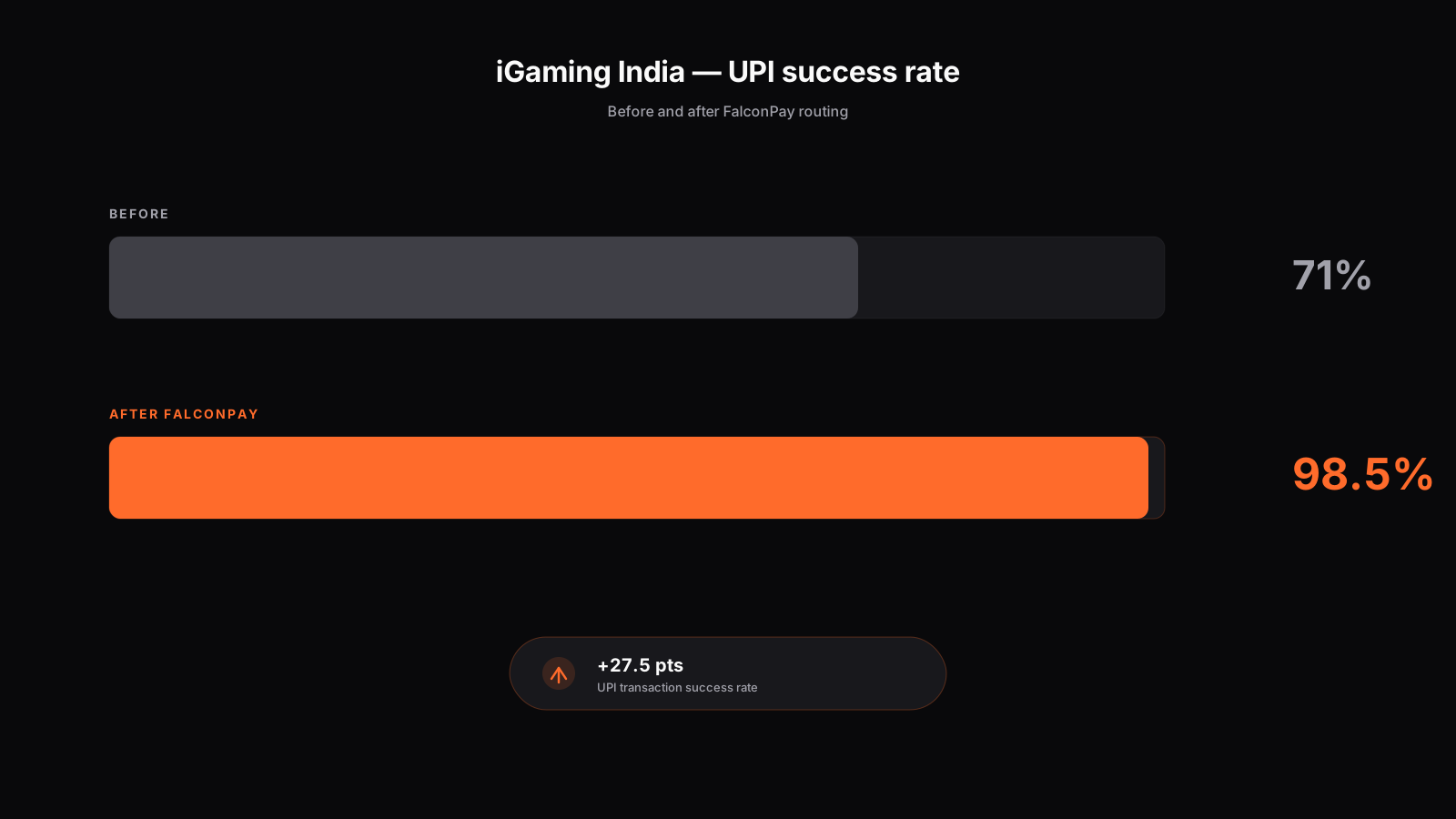
Before and after
Results — 8 months post-migration
Measured Outcomes
What this case study does not mean
Every migration narrative has the risk of being read as "we did X, therefore everyone should do X." This one has boundaries.
The merchant was compliant. GST-registered, skill-gaming structured, operating only in permitted states, issuing correct TDS. A non-compliant operator wouldn't have cleared FalconPay's underwriting, so the migration story doesn't apply to them. The right migration story for a non-compliant operator is "become compliant first."
Bank-direct routing is not magic. It is a legitimate P2M merchant flow that eliminates the P2P freeze risk — but a merchant with a fundamentally bad risk profile (extreme chargeback rates, regulator attention, sanctions exposure) wouldn't be underwritten on bank-direct either. What bank-direct buys you is the absence of intermediary-induced failures, not a licence to ignore compliance.
Success rates depend on traffic quality. 98.5% is the observed steady-state here. A merchant with heavier bot traffic, looser KYC, or traffic sources that don't match their registered operating geography would see lower numbers. The multi-bank routing helps, but it's not a substitute for good upstream traffic filtering.
For operators in a similar position
If you're operating in Indian iGaming or real-money skill gaming and you're currently on P2P routing, the honest read is that the regulatory environment has shifted and you should expect that model to continue degrading. The question is when and how to migrate, not whether.
A useful starting checklist before engaging any new processor:
- Confirm your own compliance posture — registered entity, GSTIN, skill-gaming structuring, TDS handling, state-permission mapping. If any of these are weak, fix them before migration.
- Pull your last 6 months of UPI success rate data by day. If you're seeing 85–90% steady-state, you have materially more room to gain than you think.
- Ask the prospective processor specifically whether they operate P2P, P2M-aggregated, or bank-direct. Anyone who can't cleanly answer that question is not the right provider.
- Plan for dual-path operation during cutover — don't remove the old processor until the new one has a full week of clean data.
- Model the financial impact of going from your current success rate to 98%+ on your current volume. That number is usually larger than teams expect.
Want results like these for your platform?
If you're running an Indian iGaming, real-money skill gaming, or fantasy sports operator and want to discuss bank-direct UPI routing, the FalconPay sales team responds within 4 hours on weekdays.
Start a conversation