Why Crypto Exchanges Get Rejected by Mainstream Processors
Before talking about what works, it's worth being crisp about why mainstream processors reject crypto exchanges. The reasons aren't arbitrary. They are structural properties of crypto flows that generic fraud and risk models don't handle well.
1. Chargeback asymmetry is extreme
In e-commerce, if a customer disputes a charge for a physical product, the merchant can show tracking, delivery confirmation, and signed receipts. In crypto, the picture is the opposite: once a player buys crypto and withdraws it to an external wallet, that crypto is gone. Any chargeback 60, 90, or 120 days later is an unrecoverable loss. Processors know this, and treat crypto accordingly, either refusing outright or applying chargeback thresholds so low that a single dispute wave terminates the account.
2. Velocity patterns look like fraud
A user making five $200 deposits in a day from a new card on a crypto exchange triggers every standard e-commerce fraud model. It also happens to be a legitimate pattern: someone trying to time-average-dollar into a position. Generic processors don't distinguish. Crypto-specific processors do.
3. Regulatory exposure scares bank partners
Processors route through acquiring banks, and those banks have their own AML and compliance requirements. Adding crypto exchange merchants exposes the acquiring bank to FATF travel rule scrutiny, VASP licensing questions, and money-laundering risk they weren't set up for. The easiest answer for the bank is "no crypto merchants," which flows upstream to "no crypto merchants" from the processor.
4. Brand and reputational concerns
Large processors like Stripe and PayPal make strategic decisions about brand exposure. Being publicly associated with crypto exchanges, particularly during periods of volatility, collapse, or enforcement action, is a risk their brand teams avoid. This is why the policy is blanket, not case-by-case.
What a Crypto-Capable Gateway Actually Needs to Do
A payment gateway that can actually handle crypto exchange traffic needs five things. A gateway missing any of these will fail you within 6 months.
Individual underwriting, not blanket bans
"We accept crypto" should mean "we underwrite your exchange on its own merits (business structure, KYC policy, transaction profile, jurisdiction), not against a 'crypto = bad' blanket rule." Blanket-rule processors either reject you outright or accept you and terminate 3 months later when their policy tightens.
Direct acquiring bank relationships
Aggregator-of-aggregators routing is fragile for crypto. When the upstream bank decides crypto is risky, every merchant behind that aggregator loses service with no notice. A crypto-capable gateway has direct relationships with acquiring banks that understand and underwrite crypto specifically.
Crypto-calibrated velocity and fraud rules
The rules engine needs to know the difference between "five $200 deposits in a day" as dollar-cost-averaging and "five $200 deposits in a day" as card testing. That calibration comes from processing volume in the category, not from generic ML.
FATF travel rule plumbing
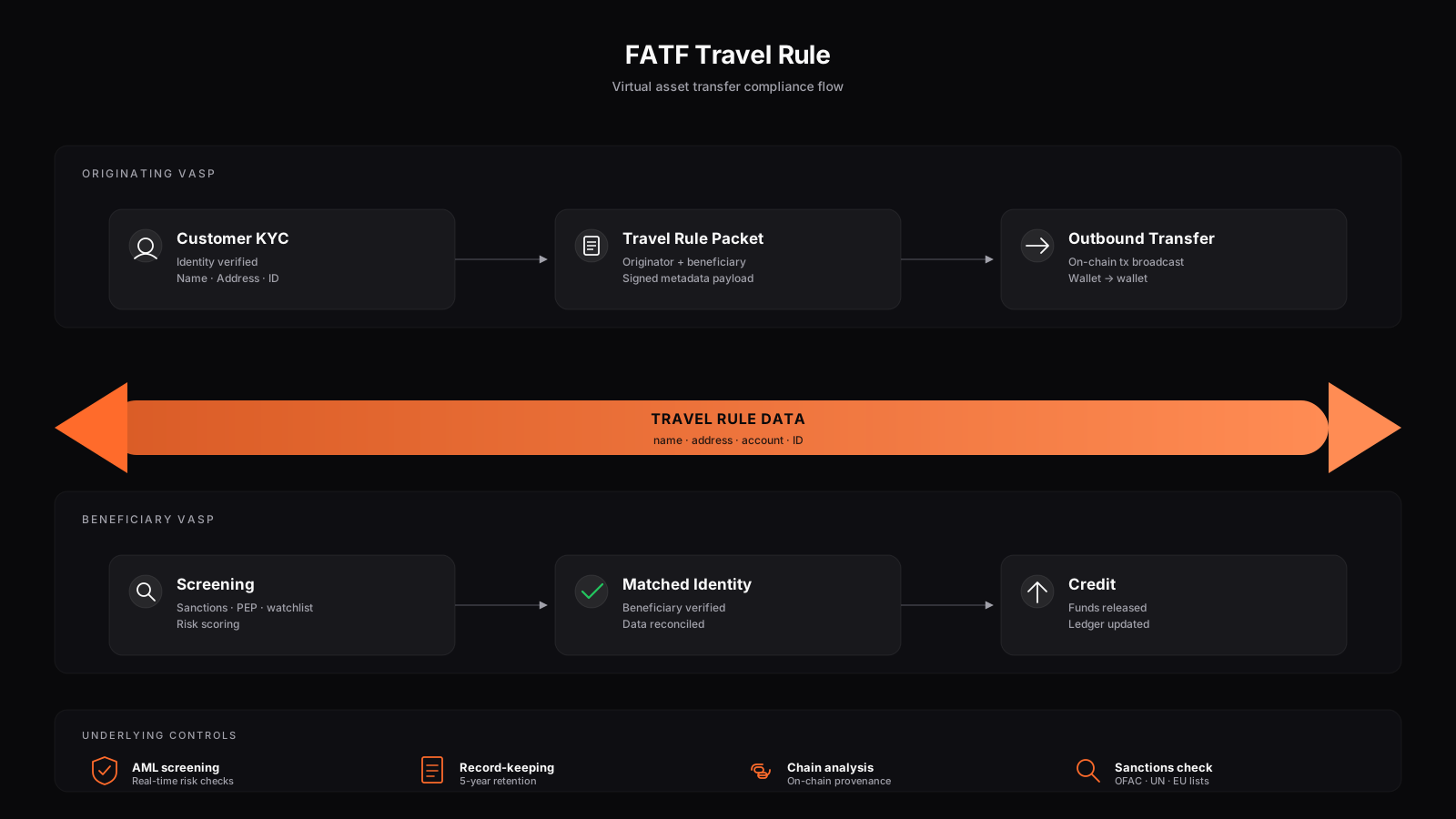
For VASP-to-VASP transactions above the travel rule threshold (currently $1,000 or €1,000 in most jurisdictions), originator and beneficiary information needs to travel with the transaction. The processor should be capturing the originator data at fiat on-ramp and tagging transactions with VASP identifiers, not leaving you to bolt that on later.
Multi-rail fiat on-ramp coverage
Your users pay in the rails of their country. If your processor only does cards, you're ignoring UPI (India), SEPA (Europe), PIX (Brazil), and more. A crypto exchange with only card processing converts meaningfully worse than one with native rails per region.
Fiat On-Ramp Options by Region
Here's what "fiat on-ramp" actually means per region, and what converts well vs. what converts badly for crypto purchases.
| Region | Best Rail | Secondary | Typical Conversion |
|---|---|---|---|
| India | UPI (bank-direct P2M) | Net Banking, IMPS, Cards | 92–98% on UPI |
| Europe | SEPA (Instant + DD) | iDEAL, Giropay, Cards | 95–99% on SEPA |
| Brazil | PIX (instant) | Boleto, Cards | 94–98% on PIX |
| USA | ACH, Wire | Cards | 88–94% on cards |
| LATAM | Local rails (MXN/COP/ARS) | Cards | Varies by country |
The pattern across regions: local rail beats card processing on conversion, typically by 4–10 percentage points. A crypto exchange serving Indian users via card-only processing is leaving 15–25% of potential volume on the table by not supporting UPI. The same pattern applies for European users without SEPA and Brazilian users without PIX.
FATF Travel Rule Compliance in 2026
The Financial Action Task Force travel rule requires that when a VASP (Virtual Asset Service Provider, i.e. your exchange) transfers crypto to another VASP above a jurisdictional threshold, both originator and beneficiary information must travel with the transaction. As of 2026, this is operational law in most FATF member jurisdictions, including the EU (via MiCA), Singapore, UAE, Switzerland, UK, and gradually in the US.
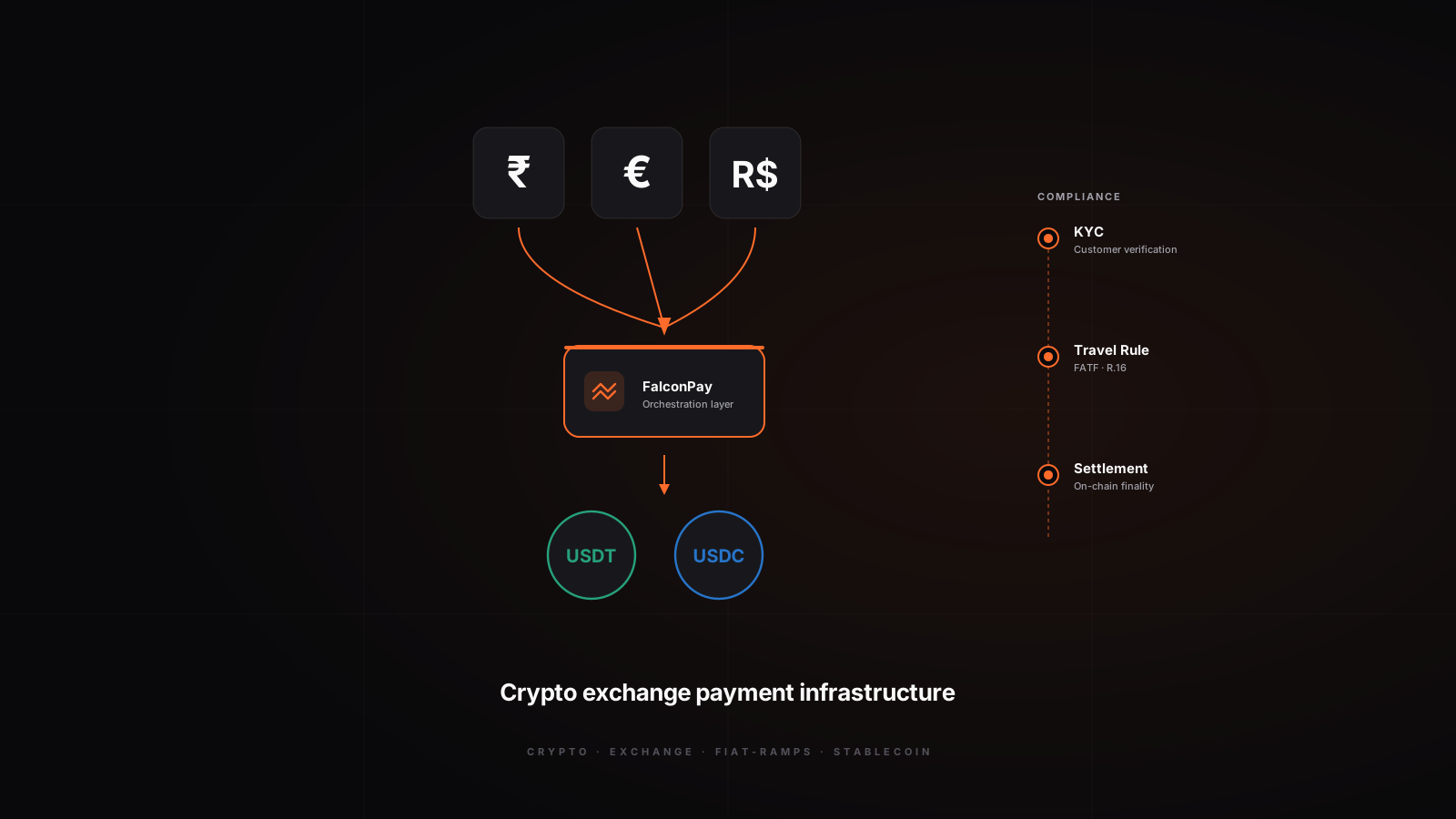
For your payment gateway, this matters because the originator data starts at the fiat on-ramp. When a user deposits INR via UPI to buy USDT, your processor should be capturing name, address, account identifier, and any required beneficiary fields, and passing them to you in a format you can use to populate travel rule messages.
What to ask a prospective processor: "Do you support Sumsub Travel Rule, Notabene, or VerifyVASP protocol integration at the transaction level?" If the answer is "what?", you'll be building your own travel rule compliance layer, and you'll discover that's much harder than it sounds.
UPI for Indian Crypto Exchanges
India is the largest single market for crypto exchange fiat on-ramp, but it's also the most complex. The Indian UPI rail for crypto has two sides to understand.
P2M (merchant) UPI vs P2P workarounds
Legitimate crypto exchange UPI flow uses P2M (peer-to-merchant) routing: your exchange is registered as a UPI merchant with a merchant VPA, and deposits flow directly from player to your merchant handle. This is what the Reserve Bank of India expects, what acquiring banks underwrite, and what survives enforcement scrutiny.
Some processors route crypto exchange deposits through P2P (person-to-person) intermediary accounts to avoid the merchant registration process. This worked in 2022–2023. In 2024–2025, the RBI cracked down on gaming and crypto P2P workarounds, and intermediary accounts started getting frozen. P2P routing for a crypto exchange in 2026 is a ticking clock. Ask any prospective processor explicitly which model they use.
30% TDS and 1% TCS
Indian crypto transactions carry a 30% tax on gains and a 1% TDS deducted at source on applicable transactions. Your processor should be able to apply the TDS at the transaction layer and provide quarterly reporting compatible with Form 26AS requirements. Doing this downstream in your own accounting is painful and error-prone.
What to expect on success rate
Bank-direct P2M UPI routing with multi-bank failover consistently delivers 97 to 99% success rates for crypto exchange deposits. P2P or single-bank setups typically sit at 85 to 90%. The 8 to 12 percentage point gap translates directly to conversion: on ₹10Cr/month of deposit traffic, that's ₹80L to ₹120L/month of recovered deposits.
SEPA for European Crypto Platforms
For European crypto exchanges, SEPA is the baseline. SEPA Instant Credit Transfer (SCT Inst) settles in under 10 seconds to banks that support it (now ~75% of European banks), which is fast enough to feel instant to the user. SEPA Direct Debit enables recurring fiat deposits, which is useful for users who want to do scheduled dollar-cost-averaging into crypto positions.
On top of SEPA, each major European market has its own dominant rail:
- Netherlands: iDEAL (70%+ of online payments)
- Germany: Giropay and Sofort (cards are secondary in DE)
- Belgium: Bancontact (90%+ of Belgian debit cards)
- Poland: BLIK (mobile-first, dominant in PL crypto)
- Sweden/Norway: Swish, Vipps, Trustly
A European crypto exchange serving only via SEPA and Visa/Mastercard misses 20 to 40% of potential conversions in specific markets. If you serve Dutch users, you need iDEAL. If you serve Polish users, you need BLIK. This isn't optional. Local rails are how Europeans pay online, and crypto is no exception.
Stablecoin Settlement Instead of Fiat Payout
The cleanest setup for a crypto exchange's treasury is to accept fiat on the on-ramp side and settle in stablecoin on the back end. Instead of your processor paying you INR to your Indian bank account, EUR to your European bank account, and BRL to your Brazilian bank account (each with its own FX exposure, settlement cycle, and reconciliation), you receive USDT or USDC in a single treasury wallet.
For a crypto exchange, this is structurally better than fiat settlement for three reasons:
- Natural match to your operations. Your treasury is already running on-chain. Receiving settlement on-chain eliminates the fiat-to-crypto conversion you'd otherwise do yourself.
- FX exposure collapses. Instead of T+3 currency exposure across multiple fiat currencies, you have a 24-hour exposure to a single dollar-pegged stablecoin.
- Cross-market treasury reallocation. Funding payouts in one market from deposits in another happens on-chain, not via slow international wires.
See our guide on USDT and USDC settlement for merchants for the full mechanics.
What Crypto-Capable Processors Look For
If you're applying for a crypto merchant account in 2026, here is what a legitimate processor wants to see. Getting these ready before you apply cuts onboarding time meaningfully.
Business registration and VASP status
Corporate registration documents, beneficial ownership, and VASP registration where applicable (MiCA in EU, MAS in Singapore, FINMA in Switzerland). Exchanges operating without VASP registration where required are non-starters.
AML and KYC policy
Your written KYC/AML policy, risk-tiering of customers, and sanctions screening setup. If you can't produce this as a document, processors assume you haven't thought about it.
Travel rule readiness
Which protocol you're integrated with (or plan to integrate with), such as Sumsub Travel Rule, Notabene, or VerifyVASP, and your approach to VASP counterparty data exchange.
Sample transaction flow
A clear diagram of "fiat in → crypto out → fiat out" showing custody, KYC checkpoints, and how your platform tracks each step. Processors use this to assess compliance posture.
Prior processing history (if any)
If you've processed with another provider, share the last 3–6 months of chargeback rate, fraud rate, and transaction volume. It shortens underwriting materially.
FAQ
Which payment gateways accept crypto exchanges in 2026?
A small list: FalconPay (global, specialised in high-risk), a handful of crypto-focused regional processors, and a few specialised offshore acquirers. The large mainstream processors (Stripe, PayPal, Adyen, Square) explicitly exclude crypto exchanges from their acceptable use policies. Banking-as-a-service providers that advertise crypto support typically require enterprise-tier monthly minimums.
Can Indian crypto exchanges use UPI legally?
Yes, with conditions. You need to be a registered Indian entity with valid business registration, comply with the 30% TDS and 1% TCS rules on crypto transactions, and use P2M (merchant) UPI routing rather than P2P workarounds. Bank-direct P2M UPI is the only structurally safe model as of 2026.
What is the FATF travel rule threshold?
The FATF recommendation is $1,000 USD equivalent. In practice, jurisdictions have adopted slightly different thresholds: €1,000 in the EU under MiCA, SGD 1,500 in Singapore, CHF 1,000 in Switzerland. Transactions above these thresholds between VASPs require originator and beneficiary information to travel with the transaction.
How long does crypto exchange onboarding take?
With full documentation ready (business registration, AML/KYC policy, VASP status, beneficial ownership, sample transaction flow), expect 48 hours on specialised processors like FalconPay. Mainstream enterprise processors that accept crypto can take 4–8 weeks.
Does chargeback risk matter if I'm settling to stablecoin?
Yes. Chargebacks happen on the fiat on-ramp side, when a user's bank reverses the card or SEPA debit. Your settlement currency (stablecoin) doesn't change the exposure on the inbound fiat. A crypto exchange still needs proper 3DS2, velocity rules, and chargeback management on the fiat on-ramp leg.
Need a payment gateway for your crypto exchange?
FalconPay provides fiat on-ramp and off-ramp across UPI, SEPA, PIX, and cards, with FATF travel rule compliance and native USDT/USDC settlement. 48-hour approval.
See Crypto Exchange Gateway →